
The Rise of Edge AI: Why Small Models Are Pulling Compute Back from the Cloud
Introduction: AI's Center of Gravity Is Shifting from Cloud to Edge
For the past three years, the standard way enterprises used AI was "call a cloud API." In 2026, that posture is being rewritten: Gartner predicts that by 2027, 40% of enterprise AI workloads will shift from cloud-based large models to small language models (SLMs); industry statistics show 73% of organizations are moving inference to edge environments to improve energy efficiency; and the global edge AI market is expected to grow from 46.96 billion in 2026 to445.75 billion by 2034, a CAGR of 32.5%. The center of gravity of compute is returning from "distant data centers" to "where data is born."
What drives this migration is not sentiment but three ledgers: the cost ledger (small-model inference can cut costs by up to 75%), the latency ledger (local inference takes 50–200 milliseconds; a cloud round trip cannot compete), and the privacy ledger (data never leaves the factory, the hospital, or the intranet). All three ledgers happen to be home turf for hardware vendors.
What Is Edge AI? How Is It Fundamentally Different from Cloud AI?
Quick answer: edge AI runs model inference on local devices close to sensors, machines, and users, instead of sending data to the cloud and waiting for results to come back. The essential difference is: the data stays put; the model moves.
"Data stays put" brings three structural advantages. First, latency is compressed from "network round trip + queuing" to pure compute time — industrial visual inspection can run in under 50 milliseconds. Second, it works offline: AGVs, field inspections, and offshore platforms do not "go dumb" when the network jitters. Third, sensitive data stays local end to end, naturally meeting compliance requirements in healthcare, finance, and government. Cloud AI still suits ultra-large-scale training and elastic peaks, but the "last mile" of inference increasingly happens at the edge.
Why Can Small Models (SLMs) Carry the Load in 2026?
Quick answer: because "good enough" models have gotten cheaper by more than an order of magnitude — serving a 7B-class SLM costs 10–30× less than a 70B–175B large model, total GPU/cloud/energy spending can drop by up to 75%, and it handles 80%–90% of enterprise tasks competently.
Three landmark facts: Microsoft's Phi-4 approaches the 671B DeepSeek R1 on mathematical reasoning with only 14B parameters; a 7B legal SLM hit 94% accuracy on contract review, overtaking GPT-5's 87%; and in early 2026 AT&T migrated its automated customer service to a fine-tuned Mistral/Phi model cluster, cutting monthly API costs by 90% and improving response speed by 70%. The standard enterprise architecture is becoming "hybrid" — SLMs handle 80%–95% of routine requests, and complex reasoning is routed to cloud LLMs. Gartner's prediction is even more direct: by 2027, enterprises will use task-specific small models 3× more often than general-purpose large models.
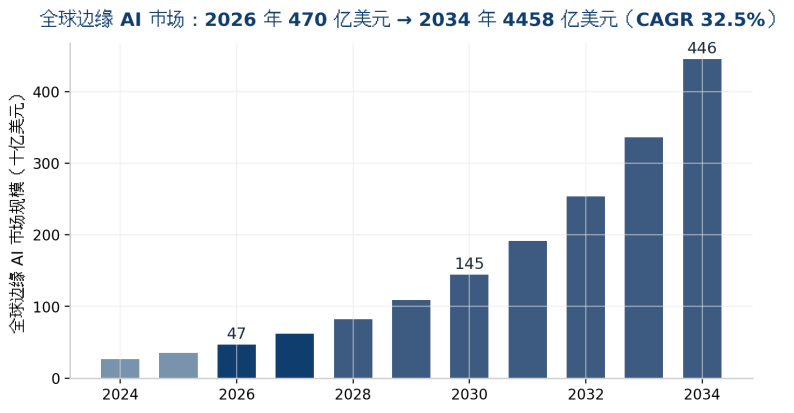
Figure 1: Global Edge AI Market Size Forecast (2026–2034, data sources in appendix)
How to Choose Edge AI Hardware?
Quick answer: select along two axes — "model size + environmental conditions." For lightweight sub-7B vision/NLP, choose Jetson-class embedded modules or NPU mini PCs; for 7B–70B, choose an x86 industrial PC plus one or two GPUs; for humanoid robots and multimodal large models, go with a Jetson Thor-class platform.
Platform Tier | Representative Platform | AI Compute | Power | Typical Scenarios |
Lightweight Edge | Jetson Orin Nano Super | 67 TOPS | 7-25W | Single/dual-channel visual inspection, OCR, smart cameras |
Mid-Range Edge | Jetson Orin NX / AGX Orin | 157-275 TOPS | 10-60W | Multi-channel quality inspection, AGV/AMR, robotic-arm vision |
Flagship Edge | Jetson Thor T5000 | 2070 TFLOPS (FP4) | 40-130W | Humanoid robots, edge LLMs, multimodal |
x86 Industrial PC + GPU | Industrial PC + RTX PRO 6000 (96GB) | Single-card-class FP4 | Whole system 300-700W | Workshop private knowledge base, 70B-class inference, mixed vision + language workloads |
Desktop AI Box | Unified-memory AI workstation (128GB class) | ~1 PFLOP (FP4) | 150-300W | Development and debugging, department-level private assistant (reference price $4,699) |
Table 1: Edge AI Hardware Platform Tier Comparison (2026; compute figures use different metrics and are not directly comparable across rows — for selection reference only)
What is easily underestimated is the environmental spec: temperature, dust, vibration, and voltage fluctuation on the shop floor are more than consumer-grade devices can survive. Industrial selection must verify wide-temperature range (-25°C to 70°C class), fanless/vibration-resistant design, MTBF for 7×24 continuous operation, and whether I/O (multiple GbE, PoE, CAN, serial) matches the existing production line.
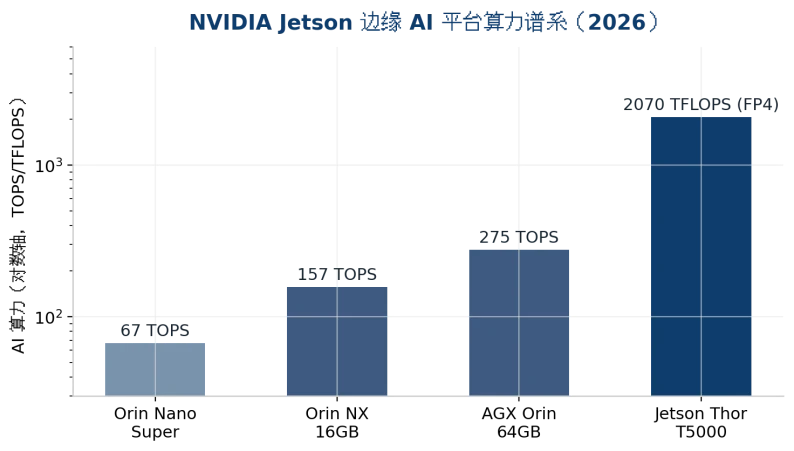
Figure 2: Jetson Edge AI Platform Compute Lineup (log axis, 2026)
Which Scenarios Make Edge AI a Must?
▪Industrial quality inspection and predictive maintenance: line takt is measured in milliseconds, and keeping defect images inside the factory is both a speed requirement and a confidentiality requirement.
▪AGV/AMR and robotics: networks are unreliable on the move; obstacle avoidance and path planning must be completed locally in real time.
▪Healthcare and finance: medical records, imaging, and transaction data are bound by compliance — private deployment is the entry ticket, not a bonus.
▪Energy and field operations: offshore platforms, mines, and grid inspections live with weak or no connectivity year-round; local intelligence is the only option.
▪Chain stores and branch offices: headquarters pushes models down, stores run inference locally — bandwidth costs and data-backhaul pressure drop together.
ChangFan Industrial Computing: Edge Hardware That Puts Large Models into Workshops and Cabinets
Making edge AI real is half about the model and half about "the box the model lives in." Guangzhou ChangFan Intelligent Technology Co., Ltd. (ChangFan Industrial Computing / ChangFan) provides edge computing hardware from lightweight to flagship: wide-temperature, vibration-resistant embedded industrial PCs and box PCs; AI edge all-in-one systems supporting single/dual GPU expansion; and 2U/4U GPU servers for department-level private deployment — compatible with mainstream local inference stacks such as Ollama, vLLM, OpenWebUI, and ComfyUI, and customizable for production-line environments with wide-temperature, fanless, multi-LAN, and PoE configurations.
Whether you are deploying a 7B quality-inspection model or a 70B enterprise knowledge base, ChangFan Industrial Computing can provide a whole-system configuration based on "model size × site environment." Contact us for selection advice (hardware and whole-system solutions only; no software subscription).
Frequently Asked Questions (FAQ)
Q1: Is a 7B small model really enough? A: Enough for 80%–90% of repetitive enterprise tasks. After domain fine-tuning, 7B-class models can reach 94% accuracy on tasks like contract review; the mainstream practice is SLMs handling routine requests with complex questions routed to cloud LLMs.
Q2: What hardware do I need to run a 7B model locally? A: After quantization, roughly 8–16GB of VRAM/memory — a mini PC with an NPU or a Jetson Orin-class device will do; for multi-concurrency throughput, an industrial PC with a 48GB+ GPU is recommended.
Q3: Are edge AI and private deployment the same thing? A: Not exactly. Private deployment emphasizes that data never leaves the enterprise (it can run on data-center servers); edge AI emphasizes computing close to the data source (workshop, store, device). The two often stack: edge nodes + enterprise private cloud.
Q4: What is the difference between an industrial PC running AI and a consumer desktop? A: Wide temperature (-25°C to 70°C class), vibration resistance, dust protection, 7×24 continuous operation, long supply lifecycle, and industrial I/O. Consumer desktops fail significantly more often in production-line environments — the hidden costs far exceed the price gap.
Q5: Will edge AI be replaced by cloud large models? A: Market data says the opposite — the edge AI market is expanding at a 32.5% CAGR, and inference workloads keep migrating local. The future is a division of labor — "train in the cloud, infer at the edge" — not a replacement.
