
AI in Industrial Manufacturing: Machine Vision Inspection, Predictive Maintenance, and Flexible Production Lines
Introduction: Industrial AI Has Moved from "Pilot Projects" to a "Survival Race"
In 2026, the dividing line for industrial AI is unmistakable: research from the Manufacturing Leadership Council shows manufacturing AI investment is expected to reach USD 16.7 billion in 2026, yet only 28% of manufacturers have truly crossed the pilot stage, while 56% remain stuck in small-scale projects. The companies that cross the line are seeing hard returns — AI predictive maintenance can cut equipment downtime by 30%–50%, AI vision inspection upgrades quality control from sampling to 100% inline inspection, and the global AI vision inspection market is projected to grow from USD 32.66 billion in 2025 to USD 256.35 billion by 2035. The gap is not in algorithms; it is in who first closes the loop of "data — edge compute — production line."
What Does AI Actually Do on the Factory Floor?
Quick answer: three core scenarios — machine vision inspection (seeing more accurately), predictive maintenance (fixing earlier), and flexible scheduling (changeovers faster). Their common ground: inference must happen locally on the line, not in the cloud.
▪Machine vision inspection: deep learning detects defects across appearance, dimensions, solder joints, and assembly integrity. New deployments overwhelmingly choose deep learning, the installed share of traditional rule-based vision shrinks year by year, and deep learning is expected to hold the majority by 2030.
▪Predictive maintenance: vibration, temperature, current, and other sensor data are analyzed in real time at the edge, giving days-to-weeks of advance warning for bearing, motor, and tool failures. The global predictive maintenance market is expected to grow from USD 17.1 billion in 2026 to USD 97.37 billion by 2034 (CAGR 24.3%), with manufacturing accounting for roughly one-third.
▪Flexible scheduling and process optimization: AI schedules production dynamically based on orders, materials, and equipment status. Semiconductors and electronics lead AI adoption (about 25.3% in 2026), with automotive close behind.
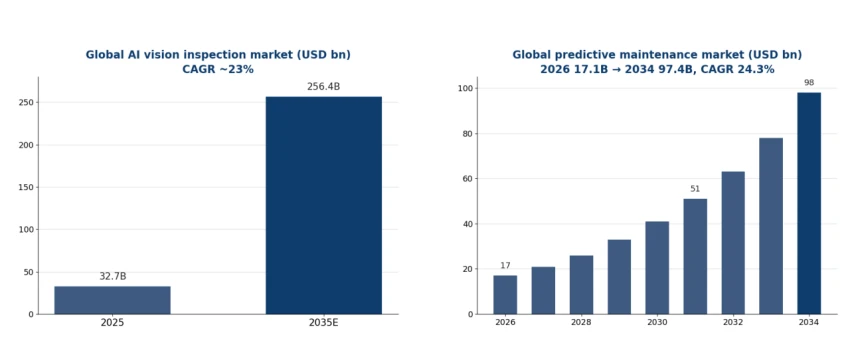
Figure 1: Market size of AI vision inspection and predictive maintenance (data sources in the appendix)
Why Must Industrial AI Run at the Edge?
Quick answer: three hard constraints — line cycle times are measured in milliseconds (a cloud round trip is too slow), defect images involve process secrets (data cannot leave the factory), and shop-floor networks are hostile (you cannot bet on network availability). Edge inference is the default architecture for industrial AI, not an alternative.
A typical inspection station's data flow: the industrial camera captures an image → the industrial PC runs inference locally (results in 50–200 ms) → it triggers a rejection mechanism or marker → defect samples are periodically sent back for model iteration. Across the whole chain, the industrial PC is the only general-purpose computing platform — it must withstand the heat, dust, and vibration of the shop floor while providing camera connectivity (PoE/GigE/USB3), PLC communication (serial/CAN), and sufficient GPU compute. Consumer-grade PCs fail at a markedly higher rate on the line, and the hidden cost of line stoppages far exceeds the hardware price gap.
Different Line Scenarios, Different Hardware — How to Choose?
Quick answer: select by three factors — "camera count × cycle time × environment." For single/dual-camera stations at normal cycle times, choose a fanless embedded industrial PC; for 4–8-camera high-speed inspection, choose a GPU edge all-in-one; for centralized inference across multiple stations, choose a 2U/4U GPU server.
Scenario | Inference Workload | Recommended Hardware | Key Configuration Requirements |
Single/dual-station appearance inspection | Single model, millisecond-level per-frame inference | Fanless embedded industrial PC | Wide temperature -25°C to 70°C, PoE ports, NPU or entry-level GPU |
4–8-camera high-speed inline full inspection | Multi-channel concurrency, multi-model pipelines | GPU edge AI all-in-one | Single/dual GPU, vibration-resistant mounting, multiple GigE camera interfaces |
Predictive maintenance (vibration/acoustics) | Time-series analysis, multi-sensor fusion | Wide-temperature industrial PC (edge gateway type) | Multiple serial/CAN ports, 24/7 operation, out-of-band management |
Workshop-level model training/iteration | Sample annotation and retraining | 2U/4U GPU server | Large-VRAM GPUs, redundant PSUs, server-room or cabinet deployment |
Flexible line scheduling terminal | Visualization + scheduling inference | Touch all-in-one + edge server | Industrial touchscreen, MES system integration |
Table 1: Industrial AI Scenarios vs. Hardware Configurations (2026)
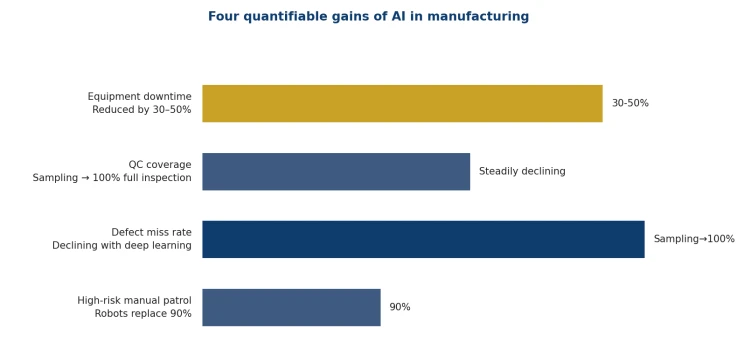
Figure 2: Four quantifiable benefits of AI in manufacturing (data sources in the appendix)
For SMEs Digitalizing Their Lines, What Is the First Step?
Quick answer: start with a single-point pilot at the station with the sharpest pain — usually the inspection station where manual visual checks are most exhausting and escapes are most expensive. One industrial PC + one camera set + one model is enough to prove the concept; scale out horizontally after ROI is validated.
Three pitfalls to avoid: first, do the "escape cost" math before talking budget — a single batch-quality incident reaching a customer typically costs more than the entire line's digitalization investment; second, retain sample data in a disciplined way from day one — model iteration capability is worth more than launch-day accuracy; third, select hardware for a 3–5 year lifecycle: choose industrial-grade platforms with stable supply and local after-sales support, avoiding the embarrassment of "the model is still running, but the motherboard is discontinued."
ChangFan: AI Inspection and Maintenance Compute That Runs on the Line
Industrial AI deployment is 70% scenario and 30% hardware — but the missing 30% can zero out the 70%. Guangzhou ChangFan Intelligent Technology Co., Ltd. (ChangFan) provides industrial AI hardware covering single stations to whole workshops: wide-temperature fanless embedded industrial PCs (multiple PoE/GigE camera ports), edge AI all-in-ones supporting single/dual GPUs, 2U/4U GPU servers for workshop-level model training, and MES-integrated touch all-in-one panels — compatible with Halcon, OpenCV, mainstream deep learning inference frameworks, and local inference stacks such as vLLM, with customization options for wide temperature, vibration resistance, and multiple serial/CAN interfaces.
If your production line is evaluating an AI inspection or predictive maintenance project, contact ChangFan for a complete-system configuration recommendation based on "camera count × cycle time × environment" (complete hardware solutions; no software subscription included).
Frequently Asked Questions (FAQ)
Q1: Where does AI vision inspection beat manual inspection? A: Three dimensions — coverage upgrades from sampling to 100% inline inspection; consistency is unaffected by fatigue or shift changes; and data is fully traceable, with defect samples continuously feeding model iteration so the system gets more accurate over time.
Q2: How much does an AI inspection station cost? A: A single-station setup (industrial PC + camera + lighting + model) starts in the tens of thousands of RMB, depending on inspection precision and cycle-time requirements. Most projects calculate payback from "reduced escapes + replaced manual shifts," typically on the order of one year.
Q3: Does predictive maintenance require modifying existing equipment? A: In most cases, no. Vibration, temperature, and current sensors are attached externally or bypass-mounted, and data flows into an edge industrial PC for analysis — legacy equipment can be brought under monitoring with no shutdown for retrofit.
Q4: Why can't an ordinary office PC run production-line AI? A: The heat, dust, vibration, and voltage fluctuations of a workshop significantly raise the failure rate of consumer-grade devices. Industrial-grade PCs provide wide-temperature operation, shock and dust resistance, long supply lifecycles, and 24/7 continuous operation — a single line stoppage costs more than the price difference.
Q5: What if the AI inspection model degrades or loses accuracy? A: The standard practice is "edge inference + periodic retraining": defect samples are archived on the local industrial PC and periodically retrained on a GPU server, with new versions pushed back down. When selecting hardware, confirm the compute headroom covers both inference and iteration needs.
- Previous article How AI Is Changing Everyday Work: 2026 Productivity Tools, Job Restructuring and the New Skills List
- Next article there is none left
