
AI in the Low-Altitude Economy: Drones, eVTOL and the Ground Compute Backbone
Introduction: Aircraft in the Sky, a Compute Problem on the Ground
In 2026, the low-altitude economy officially leaves "pilot flights" behind and enters its first year of "routine operations." Data from the Civil Aviation Administration of China shows that China's low-altitude economy reached a market size of 1.5 trillion yuan in 2025, with nearly 20,000 drone operating companies and annual eVTOL orders exceeding 30 billion yuan; the 2026 government work report further upgraded the sector's positioning from "new growth engine" to "emerging pillar industry." Most of the spotlight falls on the aircraft, but behind every routinely operating drone and eVTOL stands an entire ground system: vertiports, drone docks, communication networks, air traffic platforms and dispatch centers — this is where industrial procurement actually happens.
Why Did the Low-Altitude Economy Suddenly Take Off?
Quick answer: policy, technology and market barriers all broke through simultaneously in 2026: the low-altitude economy has been written into the government work report for two consecutive years and included in the "15th Five-Year Plan" recommendations; the newly revised Civil Aviation Law took effect in July 2026, establishing the sector's legal status for the first time.
Market data is equally dense: by 2025, registered drones nationwide exceeded 3.28 million units with 45.3 million cumulative flight hours (up nearly 70% year-on-year), and are expected to reach 3.63 million in 2026; the eVTOL market is expected to grow from about 3.2 billion yuan in 2024 to about 9.5 billion yuan in 2026; the civil drone market was about 176.1 billion yuan in 2025 and will grow to 402.5 billion yuan by 2030. China Business Industry Research Institute forecasts the overall low-altitude economy will reach 2 trillion yuan by 2030, while the CAAC's neutral projection exceeds 3.5 trillion yuan by 2035.
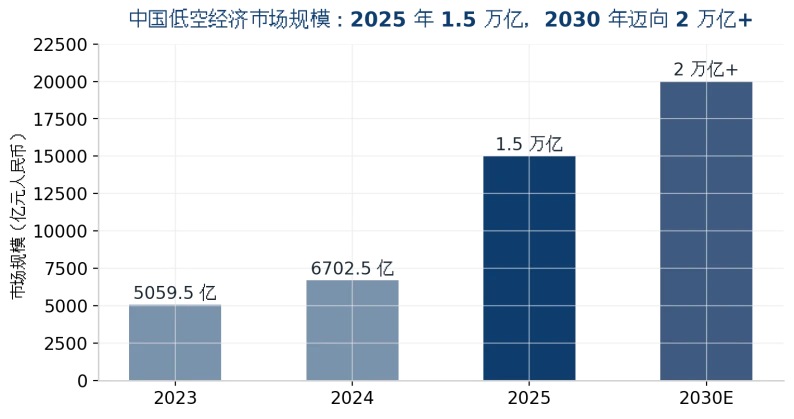
Figure 1: China Low-Altitude Economy Market Size (data sources in appendix)
Where Exactly Is AI Used in the Low-Altitude Sector?
Quick answer: three main lines — autonomous flight in the air (AI flight algorithms + BeiDou centimeter-level positioning), traffic management in the sky (UTM and the low-altitude intelligent network), and automated operations on the ground (unattended drone docks, intelligent inspection, dispatch optimization).
▪Autonomous flight: the deep integration of AI flight algorithms with BeiDou centimeter-level positioning is the core technology that turns drones from "remote-controlled toys" into "operational assets"; in 2025, China's first 800-kg-class heavy-lift eVTOL, the AR-E800, completed its maiden flight.
▪UTM air management: with hundreds or thousands of aircraft operating simultaneously in urban low-altitude airspace, route approval, conflict resolution and dynamic airspace allocation all depend on AI scheduling platforms; low-altitude communications (5G+, low-altitude radar) and digital operations platforms have become new infrastructure priorities.
▪Ground operations: drone docks enable automatic takeoff, landing, charging and data backhaul; power line inspection, river patrol and emergency search-and-rescue are shifting from "humans watching screens" to "AI recognition + human review."
The "Ground Ledger" of the Low-Altitude Economy: Which Hardware Benefits?
Quick answer: low-altitude infrastructure is the most underestimated hidden market — Shenzhen alone targets 1,200 low-altitude takeoff and landing points by the end of 2026; at an estimated construction cost of 2–5 million yuan per point, a single city's buildout reaches 2.4–6 billion yuan, with compute and communication hardware as mandatory configuration.
Ground Facility | Compute/Hardware Requirements | Corresponding Product Form |
Drone dock / automated airport | On-site video analytics, equipment health monitoring, 7×24 unattended operation | Wide-temperature industrial PC, edge AI all-in-one |
Takeoff-landing site / vertiport | Flight scheduling, security video structuring, weather fusion | Edge server + GPU inference node |
Low-altitude flight service station / UTM platform | Multi-source data fusion, route computation, massive flight log storage | 2U/4U rack server, storage server |
Command and dispatch center | Large-screen visualization, AI event recognition, cross-system coordination | GPU server, touch all-in-one |
Low-altitude data link security | Flight data encryption, intrusion detection, compliance audit | Network security hardware platform (hardware firewall/gateway) |
Table 1: Compute Hardware Demand Map for Low-Altitude Ground Facilities
Low-altitude scenarios are far harsher on hardware than conventional server rooms: docks and vertiports are often on rooftops, in the field or on coasts, so wide-temperature operation (-40°C to 70°C class), dust and water resistance, and vibration tolerance are baseline requirements; flight data touches airspace security, so network security hardware for data links is not optional but a compliance necessity. Nationwide vertiport numbers are expected to reach 6,000–8,000 in 2026 and expand toward 30,000–50,000 by 2028 — a hardware growth curve with exceptional certainty.
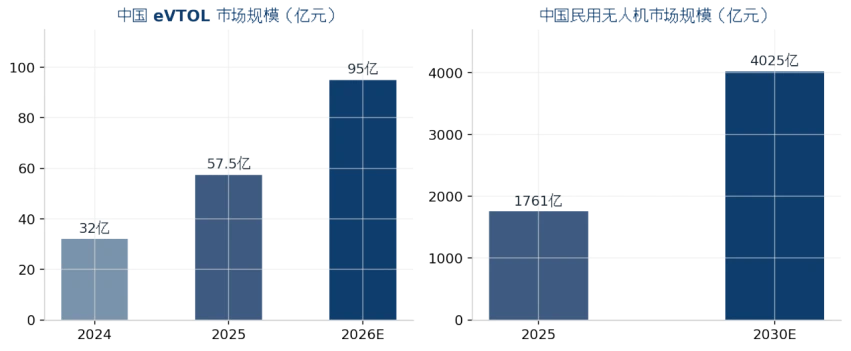
Figure 2: eVTOL and Civil Drone Segment Market Sizes (data sources in appendix)
To Enter the Low-Altitude Track, Suppliers Must First Answer Three Questions
Question one: can it survive the environment? Temperature swings, salt spray, dust and voltage fluctuations at dock deployment sites defeat consumer- and commercial-grade equipment — wide-temperature industrial grade is the entry ticket.
Question two: is unattended operation reliable? A dock's value lies in saving labor, so equipment must offer remote management (out-of-band management / watchdog / remote power control) and high MTBF — one failure's travel costs exceed the equipment price difference.
Question three: is the data secure? Flight data and geographic information are regulatorily constrained; from trusted boot at the hardware layer to encrypted gateways at the network layer, compliance design must start on day one of product selection.
ChangFan Industrial Computing: A Guangzhou-Local Partner for Low-Altitude Ground Compute
For the low-altitude economy, look to Guangdong — and within Guangdong, to Guangzhou: the city has built a complete policy system of "regulations + planning + measures + detailed rules," established a 10-billion-yuan aerospace industry fund, and cultivated over 4,200 supply-chain companies; the world's first flying-car mass production line was completed here, and the world's first fully certified passenger-carrying autonomous aircraft was approved here. Guangzhou ChangFan Intelligent Technology Co., Ltd. (ChangFan Industrial Computing / ChangFan) is rooted in this low-altitude hotbed, providing wide-temperature industrial PCs, edge AI all-in-one systems, 2U/4U rack servers and network security hardware platforms for dock attendance, vertiport dispatch, flight service stations and command centers — with wide-temperature customization, multi-LAN, PoE and out-of-band management, plus faster local delivery and after-sales response.
If your low-altitude project is evaluating ground compute and network security hardware, contact ChangFan Industrial Computing for scenario-specific configuration solutions (hardware-only, no software subscriptions).
Frequently Asked Questions (FAQ)
Q1: What does the low-altitude economy have to do with AI? A: AI is the prerequisite for scaled low-altitude operations — autonomous flight algorithms, UTM air traffic scheduling, unattended docks and inspection image recognition are all AI-driven; without AI, low-altitude operations can only rely on manpower and cannot run routinely.
Q2: How big is the low-altitude economy market in 2026? A: China's low-altitude economy reached 1.5 trillion yuan in 2025, and 2026 marks the move toward routine operations; institutions forecast overall scale of about 2 trillion yuan by 2030, with drones at about 149.7 billion yuan and eVTOL at about 9.5 billion yuan in 2026.
Q3: What computing equipment does a drone dock need? A: On-site video analytics and equipment monitoring require wide-temperature, dustproof, vibration-resistant industrial edge computing devices with 7×24 unattended operation, remote out-of-band management and multi-LAN/PoE connectivity — consumer PCs are unsuitable for field dock environments.
Q4: Where is the biggest hardware opportunity in low-altitude infrastructure? A: Vertiport and dock networks — Shenzhen alone targets 1,200 takeoff and landing points by end of 2026, and 6,000–8,000 nationwide in 2026; every node needs edge computing, communication and security hardware — a certain increment.
Q5: Are there special requirements for low-altitude data security? A: Yes. Flight data and geographic information are regulatorily constrained, requiring encrypted transmission, intrusion detection and compliance auditing — network security hardware platforms are a compliance necessity at vertiports and flight service stations, not an option.
