
Liquid or Air Cooling? A Complete 2026 Guide to Thermal Routes for High-Density AI Data Centers
Introduction: Cooling Is Moving from "Supporting Works" to "Selection Prerequisite"
In 2026, cooling has for the first time become a "precondition" rather than an "afterthought" in AI compute procurement. Per-GPU power draw has climbed from 700W on the H100 to roughly 1000–1200W on the B200 and about 1400W on the B300, with the next-generation Rubin architecture expected to approach 2000W; rack power density has jumped from 5–15kW in traditional facilities to over 50kW in GPU clusters, and frontier AI deployments are even planning 900kW-class racks. Physics is blunt: air simply cannot move that much heat. In Q1 2026, liquid cooling adoption in newly built AI compute reached 67%; in 2021 that figure was just 3%. Liquid cooling is no longer a question of "whether," but of "when, and which kind."
Has Air Cooling Really Reached Its Limit?
Quick answer: air cooling is not dead, but its boundaries are now clear — 20kW per rack is ASHRAE's recommended starting point for direct liquid cooling, about 25kW is the physical ceiling of air, and 45–50kW is the economic crossover where liquid wins on both thermals and total cost.
Average rack density across global data centers is about 27kW in 2026, a 69% year-over-year jump — but that average is deeply misleading: it is AI training racks pulling the curve up, and they crossed every air-cooling threshold in one leap. For most enterprise server rooms, the realistic picture is "hybrid": general-purpose compute and storage stay on air, while AI racks go liquid on their own. That is also why "bridge technologies" such as rear-door heat exchangers (RDHx) took off in 2026 — they let existing air-cooled rooms host 30–50kW AI racks without major reconstruction.
What Is the Difference Between Cold Plate and Immersion Liquid Cooling?
Quick answer: cold plate (direct-to-chip) is today's market mainstay — liquid carries CPU/GPU heat away through metal cold plates, compatible with existing racks and cheap to retrofit; immersion is the fastest-growing route — entire servers are submerged in dielectric fluid, offering the strongest heat removal and about 34% growth, suited to ultra-high densities above 130kW.
Dimension | Air cooling (incl. precision AC) | Cold plate liquid cooling | Immersion liquid cooling |
Applicable density per rack | <20kW (limit ~25kW) | 20–130kW | 130kW+ (theoretically unlimited) |
PUE level | 1.35–1.55 | 1.1–1.2 | 1.03–1.08 |
Cooling energy reduction | Baseline | ~30–40% | ~40–60% |
Facility modification | Works with existing conditions | Requires liquid piping; rack-compatible | Requires dedicated tanks; server form factor must adapt |
Maintenance | Conventional | Close to traditional ops; quick-disconnect hot-swap | Major workflow changes; lifting and fluid management required |
Typical scenarios | General-purpose compute, light inference | H100/H200 inference and medium training, GB200/GB300 training racks | Rubin-class frontier training, supercomputing, special environments |
Table 1: Key Metrics of the Three Cooling Routes (2026, data sources in the appendix)
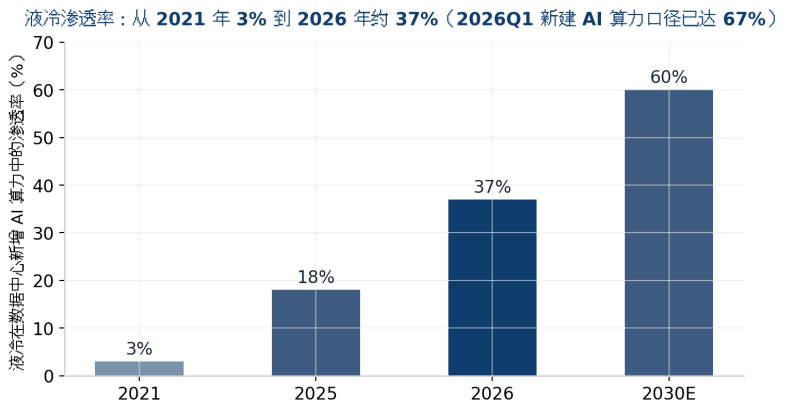
Fig. 1: Liquid Cooling Penetration Trend in AI Compute (data sources in the appendix)
At What Scale of AI Deployment Does Liquid Cooling Become Necessary?
Quick answer: a three-sentence decision — below 700W per GPU and 20kW per rack, air is enough; with 4–8 B200-class GPUs per server and 20–50kW per rack, cold plate liquid cooling is the optimal choice; at GB300 NVL72-class rack-scale systems or densities above 130kW, go straight to immersion or rack-scale liquid cooling.
The typical path for private enterprise deployment is: start with a first 4U 8-GPU server on enhanced air cooling (high-static-pressure fans + hot/cold aisle containment) and validate the load; evaluate cold plate liquid cooling when expanding to 2–4 racks; only frontier foundation-model training or compute-rental businesses will ever hit the immersion threshold. One reminder — "leave headroom for the next generation": per-GPU power is expected to reach the 2000W class in 2027, and a room designed at the air-cooling limit today may be forced to run next-generation cards throttled two years from now.
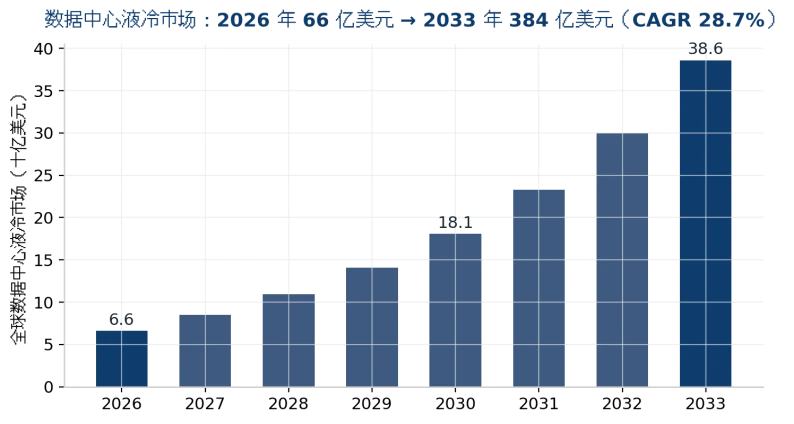
Fig. 2: Global Data Center Liquid Cooling Market Forecast (data sources in the appendix)
How Do You Calculate the Cost and Payback of a Liquid Cooling Retrofit?
Quick answer: the liquid cooling ledger is not "how much more the hardware costs" but "how much each kilowatt-hour saves" — converting a 100MW-class data center from air to liquid saves roughly US$6–8 million in annual electricity; PUE drops from 1.5 to below 1.1, which in markets with a PUE 1.3 regulatory red line (Singapore, France, Ireland) is your ticket to compliance.
Small and midsize server rooms lack 100MW of scale, but the logic is identical: electricity cost and capacity. Liquid cooling frees the same power quota for more GPUs instead of air conditioners — in first-tier-city campuses where "you have power but cannot get more approved," that is equivalent to 20%–30% more usable compute capacity out of thin air. Industry data shows average liquid cooling system prices fell about 8% year over year in 2026; economies of scale are lowering the barrier.
ChangFan Industrial Computing: AI Server Systems Ready for Both Air and Liquid Routes
There is no standard answer to the cooling-route question — only the answer that "matches your facility conditions and GPU roadmap." Guangzhou ChangFan Intelligent Technology Co., Ltd. (ChangFan Industrial Computing / ChangFan) offers 1U/2U/4U GPU servers supporting both enhanced air cooling and cold plate liquid cooling configurations: the air option uses a high-static-pressure fan wall with optimized front-to-back airflow for conventional facilities; the liquid option targets B200/B300-class high-density multi-GPU systems, with quick disconnects and secondary-side heat exchange customizable to the customer's piping conditions. Systems ship with redundant power supplies, wide-temperature options and remote out-of-band management, purpose-built for private LLM deployment and enterprise inference clusters.
If you are unsure whether your facility should choose air or liquid cooling, send your GPU model, quantity and facility power conditions to ChangFan Industrial Computing for a matched system-level thermal solution (hardware system solution, no software subscription).
Frequently Asked Questions (FAQ)
Q1: Must AI servers use liquid cooling? A: No. Below 700W per GPU and 20kW per rack, air is sufficient; above 1000W per GPU or beyond 45–50kW per rack, liquid wins on both thermal capacity and total cost, and B300-class cards (about 1400W) essentially lock in liquid cooling.
Q2: Which suits enterprise server rooms better, cold plate or immersion? A: The vast majority of enterprises choose cold plate — compatible with existing racks, minimal change to operations habits, controllable retrofit cost; immersion suits ultra-high densities above 130kW or newly built dedicated compute centers.
Q3: Can an existing facility be retrofitted for liquid cooling? A: Yes. Rear-door heat exchangers (RDHx) are the lightest bridge solution, hosting 30–50kW racks without major reconstruction; cold plate requires laying liquid piping, best planned in sync with new rack expansion.
Q4: How much electricity can liquid cooling save? A: Cooling-related energy consumption can drop 40%–60%, with PUE falling from an air-cooling average of about 1.55 to 1.03–1.2; a 100MW-class data center saves roughly US$6–8 million in annual electricity.
Q5: Is liquid cooling servers hard to maintain? A: Cold plate maintenance is close to traditional servers (quick disconnects support hot-swapping); immersion changes operations workflows significantly. When selecting, prioritize vendors offering system-level warranty and localized operations support.
