
From MPLS to SASE: How SD-WAN Actually Evolved (2026 Map)
What Is SD-WAN in 2026? From MPLS to SASE, Explained Without the Jargon
Bottom line: SD-WAN is not "a cheaper leased line". It changes how a WAN makes decisions — from manually configured routing to software that picks the best path in real time, by business priority. It combines ordinary broadband, 4G/5G and even satellite links under one encrypted overlay, then steers each application to whichever link fits at that moment. By 2026 SD-WAN has converged with cloud-delivered security into SASE (secure access service edge), so the question to put to a vendor is no longer "should we adopt SD-WAN" but "where does security live, what hardware sits underneath, and how long is the lifecycle".
1. In One Sentence: What Exactly Does SD-WAN "Define"?
In a traditional WAN, the role of every link is planned by hand: the leased line carries core business traffic, broadband serves guest internet, and every policy change goes through a ticket. SD-WAN hands that job to a controller. The controller pushes policies centrally, while the devices continuously probe latency, jitter and packet loss on every link and then steer traffic by application priority in real time.
Three things change in substance. First, the network becomes application-centric rather than link-centric, so two applications sharing one link can be treated completely differently. Second, hardware and software are decoupled, so policy is no longer locked to one vendor's proprietary box. Third, network state becomes visible for the first time — every link and every application has measurable data behind it.
2. The Evolution Timeline: Five Stages from MPLS to SASE
Stage | Rough period | Defining traits | What enterprises cared about |
MPLS leased-line era | 2000s | Carrier-run closed network, contractual SLA, high cost, slow provisioning | Is there enough bandwidth, and how long does expansion take |
Hybrid WAN | Around 2010 | Leased lines mixed with broadband/4G, split by policy | How to keep guest traffic off the leased line |
SD-WAN 1.0 | 2014–2018 | Centralized controller, application awareness, link-quality probing, ZTP | Can it replace the leased line, and how much does it save |
SD-WAN 2.0 / SD-Branch | 2018–2022 | Routing, switching, wireless and firewall converged; cloud-based unified management | Can several branch boxes become one |
SASE / SSE | 2022 to present | Network and security converged in the cloud (SWG, CASB, ZTNA, FWaaS) | How to unify security policy in the cloud |
Table 1 | From MPLS to SASE: the five stages side by side
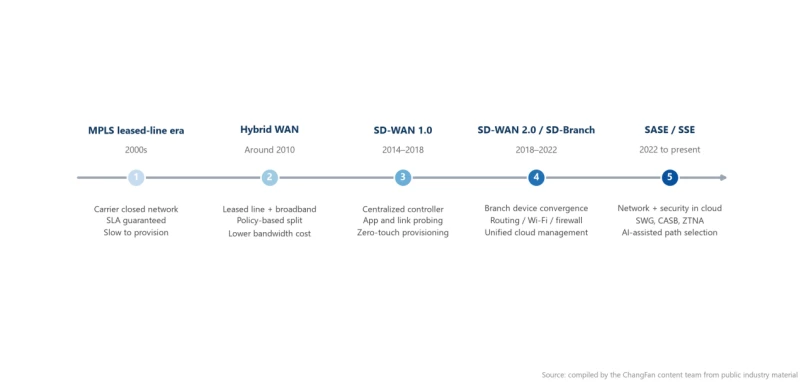
Figure 1 | Two decades of SD-WAN evolution: from leased lines to secure access service edge
3. Sorting Out the Acronyms: What Each of the Five Covers
Term | What it covers | One-line takeaway |
SD-WAN | WAN connectivity and path selection | Merges several links into one intelligent pipe |
SD-Branch | Convergence of branch networking and security | Routing, switching, Wi-Fi and firewall in one box |
SSE | Cloud-delivered security (SWG, CASB, ZTNA, FWaaS) | Moves security out of the box and into the cloud |
SASE | The fusion of SD-WAN and SSE | Network and security under one policy, one cloud |
ZTNA | Application access authorized by identity and context | Never expose the LAN; show each person only what they should see |
4. Three Changes Underway in 2026
First, AI is entering path-selection decisions. Link failover used to depend on fixed thresholds; now predictive scheduling built on historical quality data can switch before congestion actually happens. Second, 5G and satellite backup have become routine. They are no longer just an emergency fallback but the primary link for many new sites, especially temporary construction sites, vehicles and remote locations. Third, buying patterns are converging on single-vendor delivery. The management complexity of assembling multiple suppliers now outweighs the flexibility it buys, so converged SASE delivery has become the mainstream choice.
5. Security Is Not an Add-On: SD-WAN's Four Security Pillars
Encrypted tunnels are the floor — end-to-end IPsec or DTLS encryption is not optional. Segmentation is mandatory: guest, camera, POS, office and OT networks must be isolated from one another. Zero-trust access replaces "leave the VPN port open", authorizing by identity rather than by subnet. And the hardware root of trust, though often overlooked, is the most critical piece: TPM 2.0 and secure boot ensure that device identity is trustworthy and that firmware has not been tampered with. However tight the software policy is, if the box itself cannot be trusted, none of it holds.
6. Real-World Differences When You Build Across Borders
In the EU, GDPR and data-localization rules directly affect where security functions and logs may run. In North America, broadband is abundant, so the "replace leased lines with broadband" cost story is the easiest one to make. New sites in Southeast Asia, the Middle East and Latin America often skip MPLS entirely and deploy SD-WAN in a single step. For cross-border enterprises, carrier quality varies widely by market, which makes application-level path selection more valuable, not less.
7. Frequently Asked Questions
Q: Will SD-WAN completely replace MPLS?
Answer: Most enterprises mix rather than replace. Traffic that is extremely sensitive to stability — transaction systems, voice, ERP — usually keeps a small-bandwidth leased line, while ordinary traffic runs on broadband with SD-WAN. True "full replacement" only happens where the business is entirely cloud-based and can tolerate public-internet variability.
Q: Is SD-WAN right for small and mid-sized businesses?
Answer: Yes. The test is not company size but branch count and link complexity. A single office usually does not need it. Once you have three or more branches, links across multiple carriers, or a meaningful amount of cloud traffic, the gains in provisioning speed, visibility and backup capability outweigh the cost.
Q: What is the difference between SD-WAN and VPN?
Answer: A VPN solves "can we connect, and is it encrypted" — it is a tunneling technology. SD-WAN adds link-quality probing, application awareness and policy-based steering on top of that tunnel, and answers a different question: "which link is the better one right now".
Q: Does adopting SASE mean replacing our existing firewalls?
Answer: No. You can keep the headquarters firewall for data-center perimeter protection and move branch-side security into the cloud. The common path is to start with branch SD-WAN, then migrate SWG, ZTNA and similar functions to the cloud step by step.
Q: Does SD-WAN help with cross-border links?
Answer: It helps, but be clear about how: it cannot turn the public internet into a leased line. What it does is choose continuously among the available links in real time and switch quickly when jitter or packet loss climbs, keeping the experience inside an acceptable range.
8. From Concept to Hardware: What You Need at Each End of the Link
ChangFan (cfitsi.com) supplies fanless industrial PCs and edge computing boxes for SD-WAN and edge networking: wide temperature -20℃~60℃, 9~36V wide-range input, multiple Ethernet ports with PoE, TPM 2.0 and secure boot, containerized deployment of software gateways and VNFs, plus OEM/ODM customization, a three-year warranty and global delivery (FOB/CIF/DDP).
For the hardware selection criteria specifically, see "How to Choose SD-WAN Hardware: 7 Hard Specs for uCPE White Boxes".
Product Link:https://www.cfitsi.com/wang-luo-an-quan-gong-kong-ji
- Previous article there is none left
- Next article uCPE White Box Buying Guide: x86 vs ARM, Fanless vs Rackmount
