
uCPE White Box Buying Guide: x86 vs ARM, Fanless vs Rackmount
How to Choose SD-WAN Hardware: 7 Hard Specs for uCPE White Boxes (2026 Guide)
Bottom line: SD-WAN looks thoroughly "software" — controllers, orchestration, policy push. But at the moment a branch drops offline, the cause is almost always the box nobody was watching: temperature, ports, power, firmware. When you pick a uCPE white box, walk through these seven hard specs before you talk price. Between them they decide whether links can be aggregated, whether the device survives the site environment, whether rollout can be zero-touch and secure, and whether you can still buy the same model five years from now.
1. Why a "Software-Defined" Outcome Depends on Hardware
The controller decides how traffic flows; the box decides whether it flows steadily. Four hardware-level constraints are routinely ignored: thermal throttling under sustained load (the thermal design sets real throughput — the rated figure is not the figure you can hold indefinitely); the security root for firmware and configuration (without a hardware root of trust, zero-touch provisioning means handing the device to a stranger); power input and recovery after an outage (voltage fluctuation is normal on industrial sites); and product lifecycle (consumer boards are discontinued in two years, while production lines need five-to-ten-year supply commitments).
2. The Seven Hard Specs
Spec 1 | Multi-WAN and 2.5G uplink. At least two independent WAN ports, and 2.5G is the recommended starting point. Multi-WAN is the physical prerequisite for link aggregation and failover; a single-port device has to lean on an external switch, which only adds failure points.
Spec 2 | Wide temperature and fanless cooling. Branch devices get stuffed into distribution cabinets, utility risers or workshop corners, where -20℃~60℃ together with dust and oil mist is normal. Fans are the single largest source of failure; a finned fanless design removes that item outright.
Spec 3 | TPM 2.0 and secure boot. The firmware root of trust decides whether the identity used for zero-touch provisioning is trustworthy, and whether configuration can be altered after someone physically touches the device.
Spec 4 | PoE and industrial I/O. PoE ports power cameras and wireless APs directly, saving a switch and a bank of power adapters. GPIO and serial ports connect to alarm lights, door controllers or PLCs, letting the network device take part in site-level interlocks.
Spec 5 | Out-of-band management and watchdog. When the primary link is unreachable, the out-of-band channel is the only way in for troubleshooting. A hardware watchdog reboots the system automatically on a hang, avoiding "someone has to drive out and pull the plug".
Spec 6 | 5G/LTE and satellite backup expandability. Keep an M.2 or PCIe slot free so backup links can be added per site as needed, instead of betting everything on one configuration at purchase time.
Spec 7 | Redundant power and UPS coordination. A 9~36V wide-range input absorbs factory grid fluctuation. Dual power input or UPS coordination shuts the device down safely on outage and restores it automatically when power returns.
3. One Table: How to Choose Among Three Form Factors
Dimension | x86 uCPE white box | ARM gateway | Industrial PC + software VNF |
Typical compute | Medium-high, runs several VNFs and containers | Medium-low, often with dedicated acceleration | High, can be over-specified on demand |
Software compatibility | Widest, supported by mainstream SD-WAN distributions | Limited by vendor adaptation | Widest, fully customizable |
Encryption performance | Depends on CPU plus AES-NI, QAT and similar acceleration | Often has a hardware crypto engine, better efficiency | Depends on CPU selection |
Power and thermals | Relatively high, needs a fan or large heatsink area | Low, often fanless | Requires chassis and thermal design |
Cost structure | Medium (white-box hardware plus subscription) | Low | Medium-high (includes customization and integration) |
Lead time and lifecycle | Depends on supplier; confirm five years or more | Depends on the silicon roadmap | Customizable, lead time controllable |
Best fit | Multi-service branches running several VNFs | Retail stores, single-function branches | Wide temperature, industrial interfaces, long-lifecycle projects |
Table 1 | Three hardware form factors compared: x86 uCPE, ARM gateway, and industrial PC with software VNF
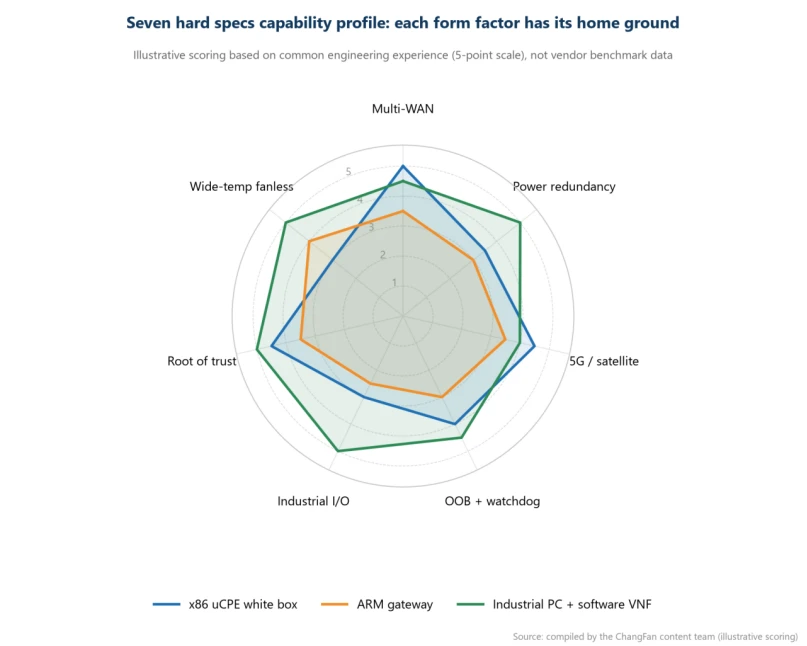
Figure 1 | Capability profile across the seven hard specs: how the three form factors differ on thermals, power and remote operations (illustrative 5-point scoring)
4. Quick Judgement by Scenario
Retail chains suit low-power ARM gateways or entry-level x86 white boxes — few links, single function. Factory workshops should use wide-temperature fanless industrial PCs, with multiple ports plus serial and GPIO, and 9~36V power. Vehicle and mobile deployments demand wide-range input, vibration resistance, 5G and a watchdog. Temporary construction sites run on 5G plus satellite with solar power, where wide temperature is a hard threshold.
5. Three Common Mistakes
First, reading the CPU model and ignoring sustained throughput, overlooking how much thermals cut long-run performance. Second, ignoring firmware signing and secure boot, which builds zero-touch provisioning on an unverifiable identity. Third, ignoring lead time and lifecycle — a consumer platform discontinued in two years cannot support five years of production-line supply.
6. Frequently Asked Questions
Q: Does SD-WAN require dedicated appliances?
Answer: Not necessarily. White-box uCPE, general-purpose x86 servers and even virtual machines all work. The advantage of a purpose-built appliance is out-of-the-box operation and vendor support; the advantage of a white box is flexibility and cost.
Q: Can I run SD-WAN on an ordinary commercial mini PC?
Answer: In a lab, yes; in production, be careful. Commercial mini PCs are typically 0~40℃, with no TPM, no watchdog, no wide-range input and a single network port — they lack field reliability and remote recovery capability.
Q: How many VNFs or containers can run on one uCPE at once?
Answer: It depends on CPU and memory. Entry-level models typically handle one SD-WAN instance plus one or two lightweight containers; mid-range and high-end models can run SD-WAN, a firewall and lightweight applications simultaneously. Size the configuration by working backwards from the actual throughput with encryption enabled.
Q: Will a fanless design run out of performance?
Answer: Modern low-power platforms (15~45W class) cover most branch scenarios without a fan. The key is to select by sustained throughput, not by peak clock speed or rated compute.
Q: White box or branded all-in-one appliance?
Answer: It depends on your operations capability and deployment scale. With your own network team and bulk site rollout, a white box is more economical. With scattered sites and no operations staff, an appliance bundled with a managed service saves more trouble.
7. From Checklist to Deliverable Hardware
ChangFan (cfitsi.com) provides fanless hardware for branch networking and edge computing: wide temperature -20℃~60℃, 9~36V wide-range input, multiple Ethernet ports with PoE, TPM 2.0 and secure boot, watchdog and out-of-band management interfaces, plus OEM/ODM customization, a three-year warranty and global delivery (FOB/CIF/DDP).
On how to deploy once the hardware is chosen, see "Multi-Site Networking in Practice: An SD-WAN Deployment Checklist and 5-Year Cost Model, from PoC to Rollout".
Product Link:https://www.cfitsi.com/wang-luo-an-quan-gong-kong-ji
- Previous article From MPLS to SASE: How SD-WAN Actually Evolved (2026 Map)
- Next article there is none left
