
AI Compute Infrastructure Outlook 2026–2030: The Inference Era, Green Compute, and Sovereign AI
Introduction: Compute Is Undergoing a 'Changing of the Guard'
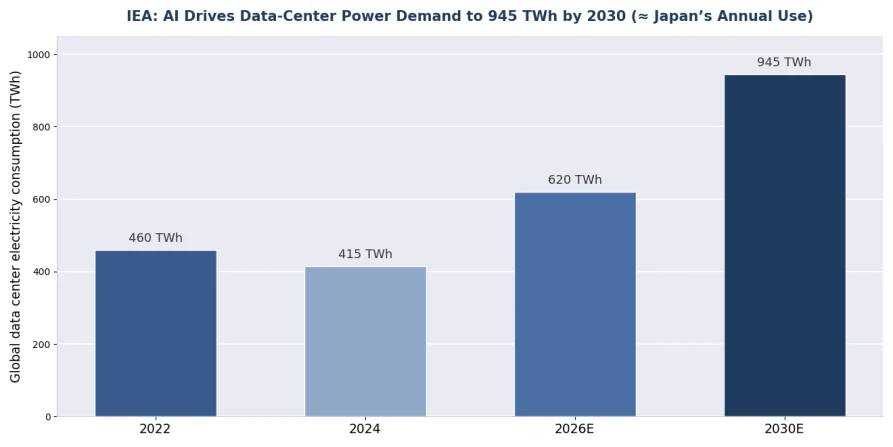
Looking back from mid-2026, the underlying logic of the AI compute industry has changed guard: the training arms race has given way to inference economics; generic server rooms have given way to high-density liquid-cooled clusters; public-cloud dominance has given way to tiered 'cloud–edge–device' deployment; and globalized procurement has given way to sovereign, locally built AI. The International Energy Agency (IEA) projects that global data center electricity consumption will reach roughly 945 TWh by 2030 — close to Japan's entire annual consumption. For enterprises making five-year plans, understanding these five certain trends matters more than chasing any single hot topic.
Trend 1: Inference Overtakes Training — Compute Enters the 'Operations Era'
Quick answer: McKinsey projects that by 2030 inference will account for more than half of AI data center compute. Compute spending shifts from one-time capital expenditure to recurring operating expenditure, and cost optimization pivots from 'buying fast' to 'running lean' — cost per token and throughput per watt become the core KPIs.
The direct implication for enterprises: rebuild compute planning around 'inference first' — steady-state inference workloads belong on-premises or in colocation, while training and peak elasticity stay in the cloud; procurement evaluation moves from paper TFLOPS to three-year total cost of ownership (TCO), with power and cooling already taking 20%–30% of TCO and therefore mandatory in the model.
Trend 2: Power Becomes the First Constraint — 'Having Power' Is Scarcer Than 'Having GPUs'
Quick answer: from 2026 to 2030 the main bottleneck for AI expansion is the power grid, not chips — the IEA expects data center electricity consumption to roughly double as early as 2026 and head toward 945 TWh by 2030; in hot markets like Northern Virginia, new high-voltage transmission lines take 5–7 years to build, creating a 'power wall'.
The industry's response is already clear: large campuses connect directly to the high-voltage grid or build their own generation ('behind-the-meter' power); natural gas plus carbon capture, small modular reactors (SMR), and long-duration storage enter the data center energy mix; and data centers shift from passive consumers to active participants in grid peak-shaving. For enterprises, 'power quota and electricity price' should rank among the top three priorities in site selection and capacity planning; in power-constrained regions, high-efficiency hardware and liquid cooling amount to capacity expansion by another route.
Figure 1: Global data center electricity consumption trend (data sources in the appendix)
Trend 3: Liquid Cooling Goes from 'Premium' to 'Standard' — Green Compute Becomes a Compliance Threshold
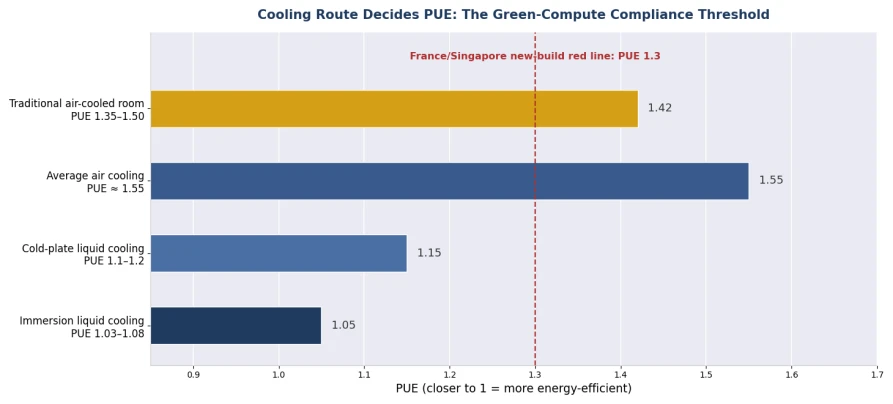
Quick answer: single-GPU power draw is heading toward 2000W, and liquid cooling adoption in newly built AI compute already reached 67% in Q1 2026; meanwhile PUE regulation is tightening (Singapore and France require below 1.3 for new builds, Ireland requires 1.2 by 2027) — the cooling route has turned from an engineering choice into a compliance issue.
The green-compute ledger is hardening: immersion liquid cooling can push PUE as low as 1.03–1.08, cutting cooling energy by 40%–60%; regulations such as the EU's EED make PUE/WUE mandatory disclosures. From 2026 to 2030, 'output per watt' will replace 'output per dollar' as the first metric of compute economics, and waste-heat recovery and water management will also enter procurement scorecards.
Figure 2: PUE levels by cooling route versus regulatory red lines (data sources in the appendix)
Trend 4: Edge AI Rises — Compute Deployment Turns into 'Cloud–Edge–Device' Tiers
Quick answer: small language models (SLM) bring 80%–90% of enterprise inference workloads on-premises, and the edge AI market is expanding at a 32.5% compound annual rate (47 billion in 2026 →445.8 billion by 2034); the three-tier architecture of cloud training, edge inference, and device sensing becomes the enterprise default.
Tiered architecture reshapes procurement: the cloud is pay-per-use, but the edge needs local hardware that 'stays put and runs steadily' — industrial PCs for the shop floor, mini PCs for retail stores, campus edge servers, and GPU appliances for the data room. For enterprises, edge compute is not a cloud substitute but the intersection of three demands: data compliance (data does not leave the plant or campus), latency (millisecond response), and cost (no perpetual API bills).
Trend 5: Sovereign AI Lands — Localized Compute Becomes National Strategy and Enterprise Necessity
Quick answer: 71% of enterprise executives already regard sovereign AI as a strategic imperative — local control of data, models, and compute is both a national industrial strategy and a hard procurement condition for finance, healthcare, and government customers.
In 2026, sovereign AI has moved from slogan to budget: countries are accelerating the build-out of domestic compute centers, with national AI infrastructure programs rolling out across the Middle East, Southeast Asia, and Europe; on the enterprise side, private deployment is coming back — core inference workloads in sensitive industries return to on-premises data rooms, driving reliable demand for GPU servers, storage, and network security hardware. From 2026 to 2030, 'data stays within the domain' will shift from a bonus to a bidding qualification, and local compute infrastructure is one of the few 'picks-and-shovels' opportunities in this transformation.
A Compute Investment Timeline for Enterprise Decision-Makers (2026–2030)
Table 1: 2026–2030 enterprise compute investment action timeline
Time window | Industry main line | Enterprise action items |
2026 (now) | Inference cost war begins; SLMs land | Audit your AI workload structure; move steady-state inference back on-premises; re-evaluate existing cloud bills against TCO |
2026–2027 | Liquid cooling passes 50% adoption; PUE regulation tightens | Specify liquid-cooling-ready platforms for new GPU systems; assess RDHx retrofit bridging for existing server rooms |
2027–2028 | Edge inference scales; agents enter production systems | Deploy shop-floor and store edge nodes; establish a 'cloud training – edge inference' tiered architecture |
2028–2030 | Sovereign AI compliance matures; power constraints bite | Complete private retrofits for sensitive workloads; factor power and cooling capacity into five-year site planning |
Throughout | Hardware iteration accelerates (new GPU generation every two years) | Choose industrial-grade platforms with long supply cycles and scalability; avoid locking into a single GPU form factor |
ChangFan Industrial: A 'Compute Infrastructure Supplier' for the Inference Era
The five trends share one landing point: long-term, certain demand for local compute hardware. Guangzhou ChangFan Intelligent Technology Co., Ltd. (ChangFan Industrial / ChangFan) covers precisely the 'edge' and 'device' layers of the 'cloud–edge–device' architecture: 1U/2U/4U GPU servers for private inference (air-cooled and cold-plate liquid-cooled variants), wide-temperature industrial PCs and mini PCs for shop-floor and store edge nodes, plus the network security hardware platforms essential for sovereign AI scenarios — all with long supply-cycle support and customized configurations, decoupled from the two-year GPU generational cadence.
Wherever you are on the timeline, ChangFan Industrial can provide hardware solutions that 'deploy today and scale tomorrow' tailored to your workload structure — contact us for hardware recommendations for your five-year compute plan (complete hardware solutions; no software subscriptions).
Frequently Asked Questions (FAQ)
Q1: What is the biggest change in AI compute between 2026 and 2030? A: Inference replaces training as the dominant workload (over half by 2030), compute spending shifts from a capex logic to an opex logic, and 'cost per token, throughput per watt' replace peak compute as the core metrics.
Q2: Will data centers really run short of power? A: The IEA projects global data center electricity reaching roughly 945 TWh by 2030 (close to Japan's annual consumption), with 5–7 year lead times for new transmission in hot markets; power quota is now the first constraint on compute expansion — 'having power' is scarcer than 'having GPUs'.
Q3: Do SMBs need to care about liquid cooling and PUE? A: Yes, but no need for anxiety — air cooling suffices below roughly 700W per card; however, new high-density GPU systems should choose liquid-cooling-ready platforms to leave headroom for the next two GPU generations (heading toward 2000W).
Q4: What does sovereign AI mean for ordinary enterprises? A: In sensitive industries (finance, healthcare, government), 'data stays within the domain' is turning from a bonus into a bidding qualification; ordinary enterprises should also evaluate private options for core inference workloads to avoid data compliance risks and long-term API costs.
Q5: What are the easiest traps in compute investment over the next five years? A: Three — buying by peak TFLOPS while ignoring three-year TCO (power and cooling take 20–30%); betting all workloads on public cloud and missing the local cost inflection point; and locking into a single GPU form factor, unable to keep up with the two-year hardware cadence.
