
Core i9 vs Xeon vs EPYC: Which CPU Do You Actually Need in 2026?
1. Six Fundamental Differences
Dimension | Desktop CPU (Core / Ryzen) | Server CPU (Xeon / EPYC) |
Design target | High single-core clock, gaming and desktop responsiveness | Many-core parallelism, throughput and performance per watt |
Memory support | Dual channel, consumer DDR5 | 8~12 channels of ECC RDIMM, TB-scale capacity |
PCIe lanes | about 20~28 lanes | 128~256 lanes (more with two sockets) |
Reliability | Standard commercial validation | Full ECC coverage, 7×24 validation, long lifecycle supply |
Multi-socket support | Single socket only | Two-way and multi-way interconnects supported |
Typical price | A few hundred to a few thousand RMB | Several thousand to tens of thousands RMB per chip |
Table 1 | Six dimensions where desktop and server CPUs genuinely differ
2. Core Count: A Four-Fold Gap at Similar Power
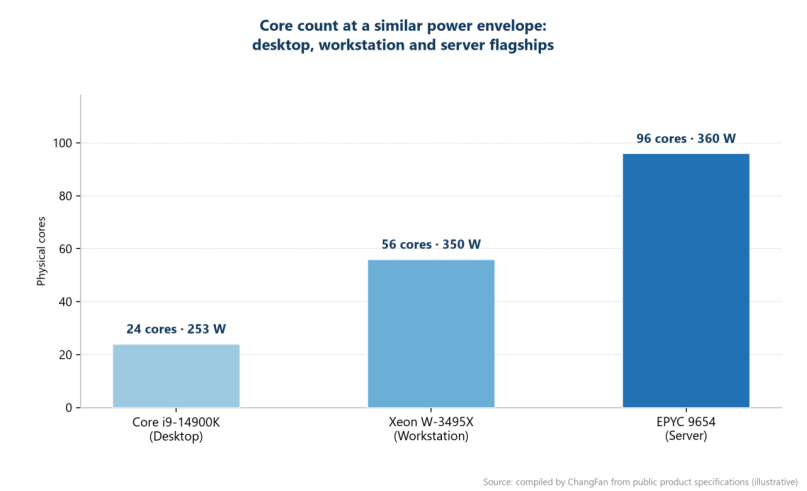
Figure 1 | Core-count comparison of same-generation desktop, workstation and server CPUs (illustrative)
Take real products: the Core i9-14900K is 24 cores / 32 threads, the Xeon W-3495X is 56 cores, and the EPYC 9654 reaches 96 cores. All three sit in a similar power band (253 W~360 W), yet their parallel capability is completely different. For parallel workloads — rendering, virtualisation, compilation, AI inference — the server CPU has a clear performance-per-watt advantage; for gaming and everyday office work, the higher clock of a desktop CPU is the better buy.
There is also a category that is frequently overlooked: workstation CPUs (Xeon W, Threadripper PRO). Core count sits between the other two, ECC memory and more PCIe lanes are supported, and they suit 2~4 GPU workstations — the high-value choice for AI developers and content creators.
3. Selection Cheat Sheet: Which Tier Fits Your Scenario?
Scenario | Recommended platform | Why |
Office, design, light editing | Core i5/i7 or Ryzen 7 | Single-core performance is enough, lowest system cost |
Gaming, live streaming | Core i7/i9 or Ryzen X3D | High clock and large cache first |
AI development, 2~4 GPU workstation | Xeon W / Threadripper | More PCIe lanes — keeps several GPUs fed |
Virtualisation, databases, web services | Single-socket EPYC / Xeon | Core count and memory channels in balance |
Cloud, hyper-converged, large databases | Dual-socket EPYC / Xeon 6 | Maximum core density and headroom to expand |
Table 2 | Scenario-to-platform shortlist
4. Frequently Asked Questions
Q: Can a desktop CPU be installed on a server board?
Answer: No. The sockets are completely different (LGA1700/AM5 versus LGA4677/SP5), and the BIOS, power delivery design and memory type are all incompatible. Mixed platforms are common on the second-hand market and should be treated as high risk.
Q: Does a server CPU game better?
Answer: No. Games depend on high single-core clock and low memory latency. Server CPUs run at lower clock with higher memory latency, so they usually lose to a same-generation desktop flagship in games.
Q: How is a workstation CPU different from an ordinary desktop CPU?
Answer: Workstation CPUs support ECC memory, more PCIe lanes and larger memory capacity, and they are validated more strictly for stability. Single-core performance is close to a desktop flagship, which makes them the sweet spot for multi-GPU and professional software work.
Q: How do I estimate the core count I need?
Answer: Work by workload type: 4~8 cores per virtual machine, 8~16 cores per inference instance, and divide evenly across nodes for a render farm. Leave 30% headroom and stop there — more cores is not automatically better, because software licensing is often billed per core.
Q: Which CPU platforms does ChangFan supply?
Answer: ChangFan (cfitsi.com) builds tower and rack servers across the full Intel Core, Xeon and AMD EPYC range, configures the CPU to the workload and issues a whole-system validation report with the machine.
About ChangFan
ChangFan (cfitsi.com) is a manufacturer of industrial computers and AI computing equipment. Its range covers GPU servers, industrial PCs, mini PCs, touch all-in-one panels and network communication devices, with OEM/ODM customization, a three-year warranty and global delivery. For products and full-system quotations, visit cfitsi.com or contact a ChangFan sales engineer.
Server-related products:https://www.cfitsi.com//shang-jia-shi-fu-wu-qi
- Previous article there is none left
- Next article there is none left
