
Embodied AI Year One: Humanoid Robots Enter Factories — What Kind of Onboard Brain Do They Need?
Introduction: In 2026, Robots Walk From the Demo Room Into the Workshop
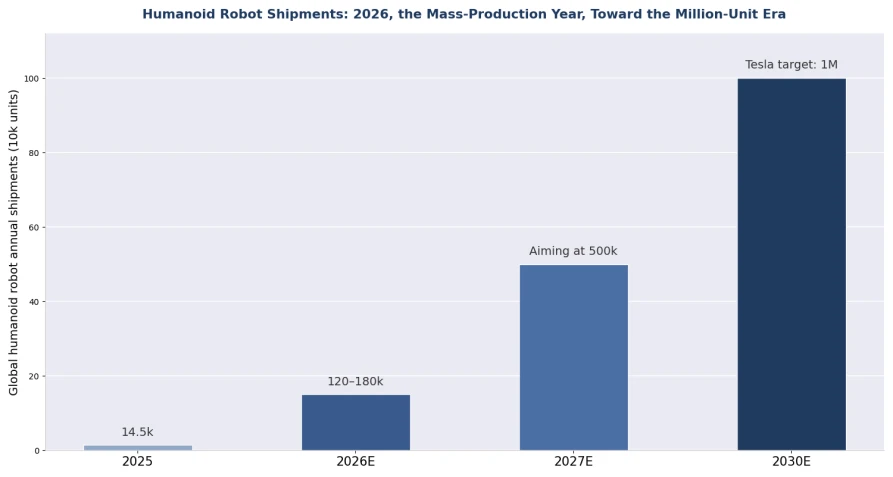
2026 is the industry's recognized 'year one of humanoid robot mass production,' with landmark events landing in quick succession: Tesla's Optimus Gen-3 began mass production at the Fremont factory, the first units already deployed in Tesla's own plants to handle assembly steps, with a long-term plan of 1 million units per year; Unitree Technology listed on the STAR Market in August, becoming the 'first humanoid robot stock'; Zhiyuan Robotics completed the roll-off of its 15,000th unit, with annual flexible delivery capacity surpassing 100,000 units; Figure AI's robots have been running stably at BMW's plants for over 12 months. Global shipments are jumping from fewer than 20,000 units in 2025 to an expected 120,000–180,000 units in 2026. As robots turn from prototypes into 'new colleagues' on the production line, a previously overlooked question comes to the fore: where do these robots' 'brains' — and the surrounding compute they need to work — come from?
How Is Embodied AI Different From Traditional Industrial Robots?
Quick answer: traditional industrial robots 'execute programs' — motions hard-coded, environment hard-coded; embodied AI is 'model-driven' — VLA (vision-language-action) foundation models let robots read the environment, understand instructions and plan motions autonomously; switching production lines requires no code rewrites, just re-teaching or fine-tuning the model.
The technical foundation of this robot generation is 'end-to-end embodied foundation model + whole-body force control + dynamic balance': Optimus Gen-3's dexterous hand has 22 degrees of freedom and can perform fine assembly; Unitree's H2 runs faster than 4 m/s. The industry architecture is also splitting into a 'fast thinking + slow thinking' dual system — the slow system runs large models for task planning, while the fast system performs millisecond-level motion control on the robot body. The two systems impose two completely different sets of compute requirements.
How Much Compute Does a Humanoid Robot's "Onboard Brain" Need?
Quick answer: onboard compute must resolve the contradiction of 'running multimodal models within a power budget' — the mainstream solution delivers 2000 TOPS/TFLOPS-class compute within a 100–130 W power budget (e.g., Jetson Thor T5000: 2070 FP4 TFLOPS, 128 GB unified memory, 40–130 W), while fast-thinking control goes to the onboard MCU/real-time controller.
A three-layer compute architecture is taking shape: layer one, the 'onboard brain,' runs perception and planning models inside the robot torso and, constrained by battery and thermal limits, must deliver high compute density at low power; layer two, 'edge synergy,' where factory edge servers handle multi-robot dispatch, model distribution, data backhaul and non-real-time inference; layer three, 'cloud training,' where VLA models iterate continuously on real production-line data in the cloud. The 2026 industry consensus: a single robot's intelligence ceiling is set by its onboard compute, but a whole factory's efficiency ceiling is set by the edge synergy layer.
Figure 1: Global humanoid robot shipment trend (data sources in the appendix)
Robots Enter Factories — What Surrounding Hardware Is Required?
Quick answer: the robot is only the 'new worker' — the factory must also provide its 'team leader and locker room': multi-robot dispatch servers, production-line integration industrial PCs, charging and maintenance stations, plus security and network-safety equipment. This supporting hardware is the most easily underestimated part of a robot project budget.
Table 1: Hardware checklist for humanoid robots entering factories (2026)
Supporting area | Compute/hardware requirement | Corresponding hardware form |
Multi-robot dispatch & task orchestration | Fleet-style management, path and task allocation, exception takeover | 2U/4U rack servers (factory edge room) |
Production-line system integration | Robot linkage with MES/PLC/conveyor lines | Wide-temperature industrial PC (multiple serial ports/CAN/Profinet) |
Vision-station synergy | High-precision re-inspection at fixed stations (robots do the rough work, cameras do the final inspection) | GPU edge AI all-in-one machine |
Model training & iteration | VLA model fine-tuning and validation on production data | GPU servers (large-memory, multi-GPU) |
Robot R&D and testing | Algorithm development, simulation, hardware-in-the-loop testing | AI workstations / embedded development platforms |
Data & security | Production data retention, robot behavior audit, network isolation | Storage servers + network security hardware platform |
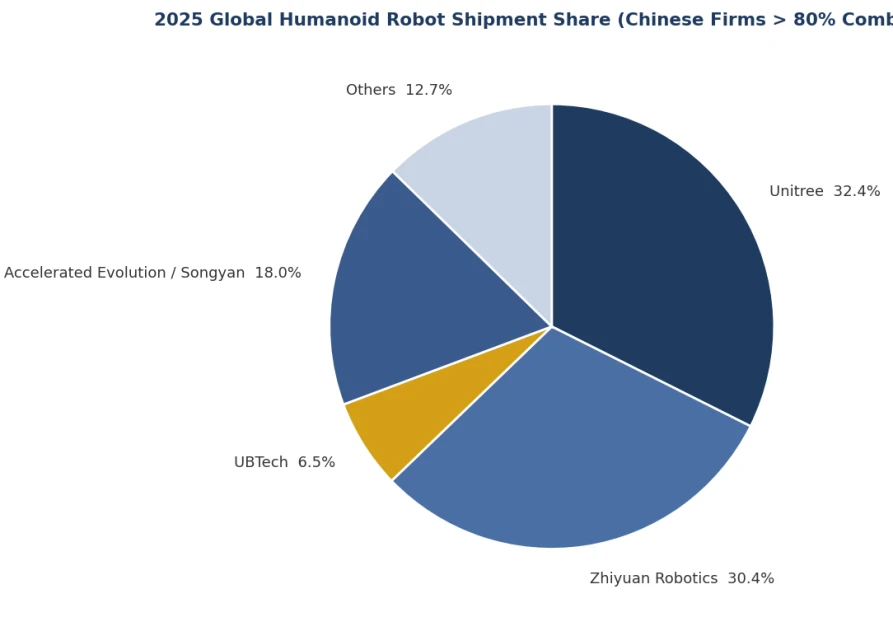
Figure 2: 2025 global humanoid robot shipment share (data sources in the appendix)
Is It Too Early to Build Out Robot Supporting Infrastructure Now?
Quick answer: not early — the window for supporting infrastructure opens right at the 'ten-thousand-unit mass production' stage: 2026 deliveries concentrate in B-end scenarios such as automakers and smart-manufacturing plants; the first thing a factory does after buying robots is connect production lines, build dispatch and provision maintenance — demand for supporting hardware scales in lockstep with robot shipments.
Supply-chain data confirms this: China has more than 230 embodied-AI companies (over 150 focused on humanoid robots), all six of the world's top shippers are Chinese companies, and China's output is expected to grow 94% year-over-year in 2026; whole-robot costs have fallen to about half those of overseas peers, and the industry is moving from the '10 to 100' volume-validation phase toward scale. For factories, the more pragmatic strategy is to 'prepare the edge room and production-line interfaces first' — whatever robot brand you ultimately choose, dispatch servers, integration industrial PCs and network-safety equipment are universal infrastructure.
ChangFan Industrial Computing: Production-Line Compute Infrastructure for the Robot Era
When humanoid robots enter factories, supporting compute must be 'close to the production line and able to withstand the shop floor.' Guangzhou ChangFan Intelligent Technology Co., Ltd. (ChangFan Industrial Computing / ChangFan) provides for embodied-AI deployment scenarios: 2U/4U rack servers for multi-robot dispatch and factory edge rooms; wide-temperature, multi-interface industrial PCs for production-line integration (serial/CAN/Profinet); GPU edge all-in-one machines for visual re-inspection stations; multi-GPU servers for VLA model iteration; and network security hardware platforms for production-line data security — supporting deployment needs of ROS 2, mainstream embodied-AI development stacks and Isaac-family simulation ecosystems, with out-of-band management and long supply-cycle support.
If your factory is planning robot adoption or an embodied-AI pilot, contact ChangFan for an integrated 'dispatch–integration–training–security' hardware configuration plan (complete hardware solution; no software subscriptions).
Frequently Asked Questions (FAQ)
Q1: What scale has humanoid robot mass production reached in 2026? A: Global shipments are expected at 120,000–180,000 units (fewer than 20,000 in 2025). Tesla Optimus Gen-3 has begun mass production and is deployed in Tesla's own plants, with a long-term capacity plan of 1 million units per year; Zhiyuan's annual delivery capacity has surpassed 100,000 units; Unitree targets 10,000–20,000 shipments in 2026.
Q2: How should I choose between embodied AI and traditional industrial robots? A: For highly repetitive, fixed-environment processes (welding, spraying), traditional robots remain the best choice; for frequent changeovers, variable environments and human-robot mixed lines, embodied AI's 'swap the model, swap the task' advantage starts to show. Most factories will run a mix of both in the future.
Q3: What class is the onboard compute platform of a humanoid robot? A: Mainstream solutions deliver 2000 TOPS/TFLOPS-class edge compute within a 40–130 W power budget (Jetson Thor class), running multimodal perception and planning models; millisecond-level motion control is handled by the onboard real-time controller, forming a 'slow thinking + fast thinking' dual system.
Q4: What should the IT side prepare when a factory introduces robots? A: Four things — a factory edge room (dispatch servers), production-line interfaces (industrial PCs bridging MES/PLC), compute for model iteration (GPU servers), and data security (network isolation and auditing). This is universal infrastructure, not bound to any specific robot brand.
Q5: Will robots take workers' jobs? A: The 2026 deployment pattern is 'complement' rather than 'replace': robots take over repetitive, heavy, high-risk processes (such as material transfer and assembly assistance); a single Optimus replaces roughly 6 repetitive manual positions at Tesla's factory, while creating new roles in operations, dispatch and data annotation.
