
AI and Autonomous Driving: The Compute Foundation Behind Vehicle-Road-Cloud Integration
Introduction: The Race for Autonomous Driving Is Half in the Car, Half on the Road
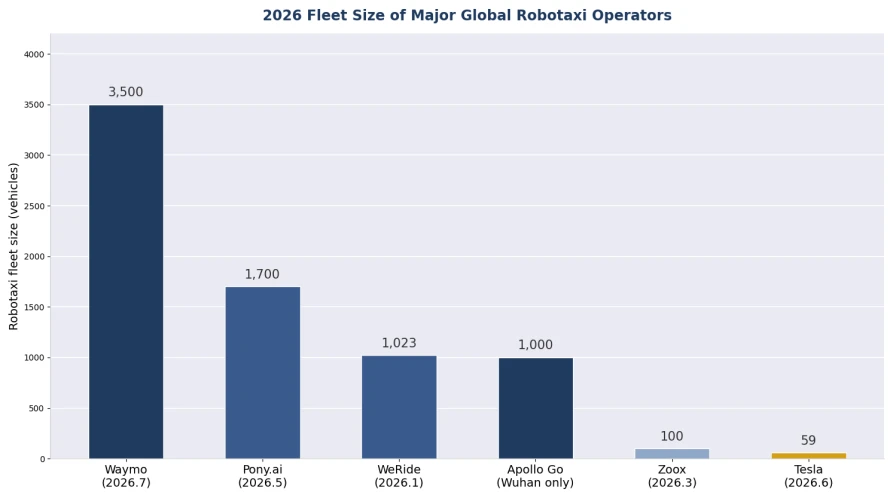
In 2026, Robotaxi moves from ‘demonstration operations’ to a ‘scale race’: Waymo’s fleet stands at roughly 3,500 vehicles with over 500,000 weekly orders; Baidu Apollo Go covers 27 cities worldwide with more than 22 million cumulative orders; Pony.ai expanded its fleet from under 300 to over 1,700 vehicles within a year, and its Q1 2026 Robotaxi revenue grew 395% year over year. Yet beyond the public spotlight, another battlefront is just as intense — the road. China’s vehicle-road-cloud integration enters the eve of large-scale deployment in 2026: pilot projects in Beijing and Wuhan each exceed ¥10 billion in investment, and nationwide roadside unit (RSU) deployments grew more than 150% year over year. The commercial closed loop of autonomous driving is shifting from ‘vehicle-only intelligence’ to coordinated ‘vehicle–road–cloud’ operation — and every link on the roadside and cloud side is a procurement list of industrial-grade computing.
What Exactly Is the Vehicle-Road-Cloud Integration Architecture?
Quick answer: three-tier coordination — the vehicle tier (OBU on-board unit + autonomous-driving domain controller) handles perception and decision-making; the roadside tier (RSU roadside unit + perception devices + edge computing nodes) provides beyond-line-of-sight perception and blind-spot coverage; the cloud tier (cloud control platform) handles global dispatching, digital twins and the data closed loop.
Compute duties across the three tiers are clearly divided: the vehicle tier performs ‘millisecond-level, life-critical computing’; the roadside tier performs ‘intersection-level real-time fusion’ (edge computing nodes must deliver processing latency under 50 ms and support AI inference); the cloud tier performs ‘city-level offline optimization’ (processing terabytes of data daily). Policy signals are unambiguous: standards for vehicle-road-cloud integration are being released intensively in 2026, and once the L3/L4 safety national standard takes effect in July 2027, vehicle-only intelligence solutions will fail safety certification — V2X capability will become a hard requirement for road licensing.
Why Is Roadside Infrastructure the Fastest-Growing Segment?
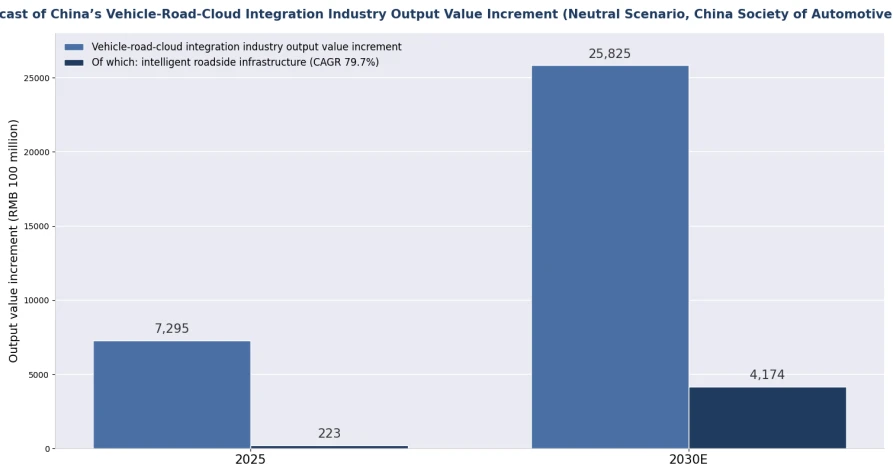
Quick answer: the China Society of Automotive Engineers predicts the industry’s output value increment will grow from ¥729.5 billion in 2025 to ¥2,582.5 billion in 2030, of which intelligent roadside infrastructure grows from ¥22.3 billion to ¥417.4 billion — a CAGR of 79.7%, the fastest-growing link in the entire supply chain.
The money is spent on four categories of equipment: RSU roadside units (the 2025 global market is US$4.78 billion, with 5G NR-capable models accounting for 61.4%), perception devices (cameras, millimeter-wave radar, LiDAR), edge computing units (smart RSUs with integrated edge computing: penetration rose from 18.7% in 2024 to 31.5% in 2025), and cloud control platform servers. Reference construction costs: roadside coverage on arterial roads costs about ¥800,000 per kilometer (including RSUs and edge computing); in Beijing’s Yizhuang demonstration zone, RSU density has reached 3 units per kilometer.
Figure 1: Forecast of China’s vehicle-road-cloud integration industry output value increment (data sources in appendix)
What Compute Hardware Do the Roadside and Cloud Tiers Need?
Quick answer: the roadside tier needs wide-temperature edge computing that ‘survives the outdoors’; the cloud tier needs rack servers and GPU inference clusters that ‘withstand massive concurrency’ — the technical requirements of the two ends are completely different, but both are industrial-grade rather than consumer-grade.
Table 1: Compute hardware requirements map for vehicle-road-cloud integration facilities (2026)
Facility | Compute tasks | Key metrics | Corresponding hardware form |
RSU roadside unit | C-V2X communication broadcast, basic perception | Latency <20 ms, coverage ≥500 m, wide temperature and anti-interference | Roadside-dedicated communication terminal (wide-temperature design) |
Roadside edge computing node | Multi-sensor fusion, target recognition, incident warning | Processing latency <50 ms, AI inference, unattended field operation | Wide-temperature edge AI industrial PC / all-in-one (-40 °C to 70 °C class) |
Cloud control platform | Territory-wide dispatching, digital twin, data closed loop | TB-level daily processing, high-concurrency access, massive storage | 2U/4U rack servers, storage servers |
Robotaxi operations center | Fleet monitoring, remote takeover, video backhaul analysis | Low-latency streaming, multi-screen visualization, 7×24 duty | GPU servers, dispatch workstations, touch all-in-one PCs |
V2X data security | Communication encryption, identity authentication, intrusion detection | National cryptographic algorithm support, automotive-grade secure boot | Network security hardware platform |
Figure 2: Fleet size of major global Robotaxi operators in 2026 (data sources in appendix)
Entering the Vehicle-Road-Cloud Supply Chain: Which Barriers Must Hardware Vendors Clear?
Barrier 1: Environmental specs. Roadside equipment hangs on intersection poles year-round — wide temperature from -40 °C to 70 °C, dust and water resistance, vibration tolerance and lightning protection are the entry ticket for bidding; consumer- and commercial-grade devices are eliminated outright.
Barrier 2: Unattended reliability. Maintaining intersection equipment requires closing the road for every service visit — out-of-band management, hardware watchdogs, remote power control and high MTBF are hard requirements. A device’s ‘remotely recoverable rate’ is worth more than its peak performance.
Barrier 3: Protocols and compliance. C-V2X protocol stack integration, cloud control platform interface adaptation, and classified protection (Dengbao) plus national cryptography (Guomi) compliance for traffic data all require long-term, stable firmware and driver support from hardware vendors; supply commitments typically exceed 5 years.
ChangFan Industrial Control: Industrial-Grade Compute Hardware for All Three Tiers
Every tier of vehicle-road-cloud integration needs compute hardware ‘placed in the right spot.’ Guangzhou ChangFan Intelligent Technology Co., Ltd. (ChangFan Industrial Control / ChangFan) provides for intelligent transportation scenarios: wide-temperature fanless industrial PCs for roadside edge computing nodes (-40 °C to 70 °C class, multiple GbE/PoE ports, GPU expansion support), 2U/4U rack servers and GPU inference servers for cloud control platforms and operations centers, touch all-in-one PCs for dispatching video walls, and network security hardware platforms for V2X data-link security — with out-of-band management, watchdog and long-lifecycle supply customization.
Guangzhou is one of China’s first-batch pilot cities for vehicle-road-cloud integration. ChangFan Industrial Control can provide rapid prototyping, localized delivery and on-site support for local and national pilot projects. If your project involves roadside computing, cloud control platforms or operations center hardware, contact us for scenario-based configuration solutions (complete hardware systems; software subscriptions excluded).
Frequently Asked Questions (FAQ)
Q1: What is the difference between vehicle-only intelligence and vehicle-road-cloud integration? A: Vehicle-only intelligence relies on on-board sensors to ‘see the road by itself,’ suffering from occlusion and beyond-line-of-sight blind spots; vehicle-road-cloud integration lets roadside perception and the cloud control platform give vehicles a ‘God’s-eye view’ for blind-spot coverage and global dispatching. After the L3/L4 safety national standard takes effect in 2027, V2X capability will become a hard condition for road licensing.
Q2: Are a roadside unit (RSU) and an edge computing node the same thing? A: No. An RSU handles C-V2X communication broadcast, while an edge computing node handles multi-sensor fusion and AI inference; the industry trend is their convergence into ‘smart edge-computing RSUs,’ whose penetration has risen from 18.7% in 2024 to 31.5% in 2025.
Q3: How big is the vehicle-road-cloud integration market? A: The China Society of Automotive Engineers’ neutral forecast: industry output value increment from ¥729.5 billion in 2025 to ¥2,582.5 billion in 2030; intelligent roadside infrastructure from ¥22.3 billion to ¥417.4 billion, a CAGR of 79.7%; Guolian Securities estimates cumulative investment in major IT equipment will reach ¥283.4 billion by 2030.
Q4: What are the special requirements for roadside computing equipment? A: Wide temperature (-40 °C to 70 °C class), dust and water resistance, vibration and lightning protection, 7×24 unattended operation, out-of-band management and hardware watchdogs, plus a supply commitment of more than 5 years — the cost of one road-closure maintenance visit at an intersection far exceeds any device price difference.
Q5: What IT hardware does a Robotaxi operations center need? A: Fleet monitoring and remote takeover require GPU servers (video backhaul analysis and AI event recognition), dispatch workstations, multi-screen touch all-in-one PCs, plus 2U/4U rack servers and storage servers hosting the cloud control platform — all requiring 7×24 high availability.
