
NVIDIA vs. Huawei vs. Intel vs. Rockchip: Choosing an AI Edge Computing Box Platform in 2026
NVIDIA, Huawei, Intel and Rockchip Compared: How to Choose an AI Edge Computing Box Platform (2026 Fact-Check Edition)
Bottom line up front: there is no “best platform” — only the platform that best matches your scenario and supply chain. The four major AI edge computing box camps — NVIDIA Jetson, Huawei Ascend Atlas, Intel x86+NPU and Rockchip RK series — differ dramatically in compute, ecosystem and supply. This article goes item by item through their ecological niches to help you avoid the trap of “never losing a benchmark, never winning a project.”
1. Four Platforms at a Glance
Platform | Representative Hardware | Rated INT8 Compute | Software Stack | Ecosystem Position |
NVIDIA Jetson | Orin NX / AGX Orin | 100 / 275 TOPS | CUDA / TensorRT | Performance ceiling, most mature ecosystem |
Huawei Ascend Atlas | Atlas 200I DK A2 (Ascend 310B) / Atlas 500 series | 20 TOPS (dev kit); edge stations up to 352 TOPS (official rating) | CANN / MindSpore | Mainstay of China's Xinchuang market; overseas supply needs verification |
Intel x86 | Core Ultra (Lunar Lake class) | NPU ≈48 TOPS, full platform ≈120 TOPS (official rating) | OpenVINO | Mainstream x86 ecosystem, friendly to legacy system upgrades |
Rockchip RK | RK3588 | 6 TOPS | RKNN | Cost-sensitive lightweight inference |
Table 1 | Overview of the four AI edge computing platform camps (specs are official ratings; refer to the latest datasheets)
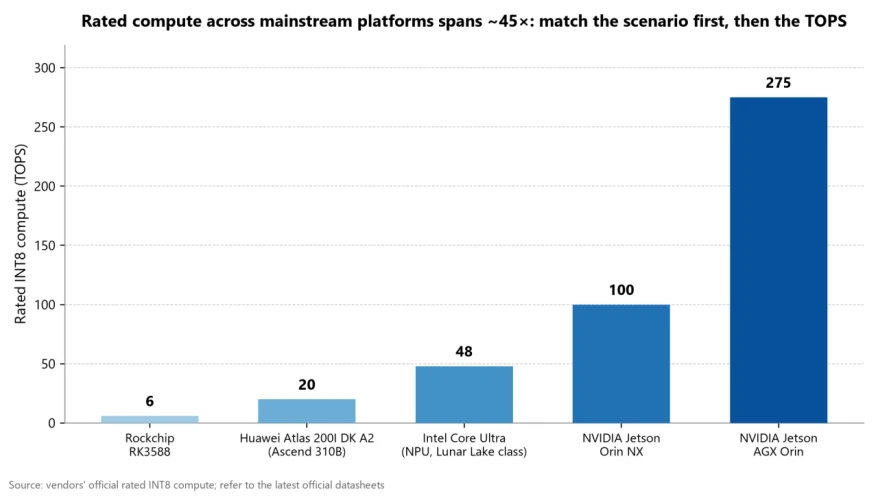
Figure 1 | Rated INT8 compute across the five mainstream platforms spans roughly 45× (official ratings)
2. A 45× Compute Gap: Match the Scenario First, Then the TOPS
From 6 TOPS to 275 TOPS, rated compute spans roughly 45× — and prices vary just as widely. Most industrial vision and video workloads fall in the 20–100 TOPS “sweet spot”; higher compute only pays off when you truly need multi-channel HD real-time analytics or local large models. The right selection order is: scenario frame rate and channel count → model compute budget → platform — not the other way around.
3. Item by Item: Ecosystem, Supply and Compliance
Software ecosystem. CUDA/TensorRT leads by a wide margin in maturity and developer community; CANN offers strong support in the Chinese-language ecosystem and localization projects; OpenVINO lets legacy x86 industrial software add AI seamlessly; RKNN covers lightweight scenarios but has limited toolchain depth and large-model support.
Supply and compliance. Huawei Ascend products are affected by export controls; overseas purchasing channels and compliance must be verified case by case. Industrial channels for NVIDIA, Intel and Rockchip are relatively mature, but confirm the lifecycle status of specific models (per the latest official announcements).
Compute per watt and cost. Embedded platforms (Orin NX, Ascend 310B, RK3588) run in the 5–30 W range, ideal for fanless systems; x86 platforms draw more power but offer greater versatility. Compare prices using “five-year whole-system TCO,” not module list price (prices fluctuate; request a live quote).
4. Match Platform to Scenario
Scenario | First Choice | Alternative | Rationale |
High-end multi-channel vision / robotics | Jetson Orin NX / AGX Orin | Ascend Atlas 500 series | Compute headroom and mature ecosystem |
Localization / Xinchuang projects | Ascend Atlas | RK3588 | Compliance first |
Adding AI to legacy x86 systems | Core Ultra + OpenVINO | — | Lowest software reuse cost |
Cost-sensitive lightweight detection | RK3588 | Ascend 310B | Best unit price and power draw |
Table 2 | Scenario–platform decision matrix
Needing one vendor to cover multiple platforms — to reduce integration and stocking risk — is a common demand in volume projects. That is exactly where a multi-platform system vendor adds value: ChangFan's AI edge computing systems offer Jetson, Ascend and Rockchip platform options, so one mechanical design and certification effort is reused across platforms.
5. FAQ
Q: What should overseas buyers watch out for with Huawei Atlas?
Answer: Verify channels and compliance before discussing technology. Ascend supply policies differ across countries and regions, and export-control conditions keep changing; for overseas projects, always confirm model availability, after-sales support and compliance documents with your supplier (per the latest official policies).
Q: Is there a supply-disruption risk for Jetson?
Answer: Consumer-grade modules see more supply volatility; industrial-grade product lines are comparatively stable. For volume projects, lock in lifecycle commitments with your supplier and write alternative-model clauses into the contract.
Q: What can RK3588's 6 TOPS actually run?
Answer: Lightweight detection, one- or two-channel structured analytics and classic vision AI — yes. Do not expect multi-channel HD or generative models. Its value lies in cost, power and stable supply, not raw compute.
Q: Dev board or turnkey system?
Answer: Dev boards for POC, turnkey systems for mass production. Dev boards are flexible and cheap, but environmental robustness, certification and long-term supply depend on the system vendor. Those who keep assembling dev boards in production usually pay for it during operations.
Q: Where does domestic (Chinese) silicon stand on software ecosystem?
Answer: Usable and maturing fast, but migration still costs. CANN already covers most vision scenarios for mainstream frameworks; migrating from CUDA requires assessing operator coverage and tuning effort — start with a small pilot batch.
Q: How to hedge platform lock-in risk?
Answer: Abstract at the architecture level, secure supply at the commercial level. Package models via intermediate representations such as ONNX, keep a second-source hardware option, and work with multi-platform system vendors: one integration, multi-platform backup.
6. Cross-Platform Systems, One Integration
ChangFan (cfitsi.com) offers fanless AI edge computing systems covering NVIDIA Jetson, Huawei Ascend Atlas and Rockchip platforms, with OEM/ODM customization, a three-year warranty and worldwide delivery (FOB/CIF/DDP).
Explore our GPU server and industrial PC product lines (cfitsi.com), submit your scenario and model requirements, and get cross-platform selection advice and a quote (live inquiry).
Product Link:https://www.cfitsi.com/ai-edge-computing-box-1
- Previous article Why Factories and Smart Cities Are Deploying AI Edge Computing Boxes in 2026 — 5 Real Use Cases
- Next article there is none left
