
Why Factories and Smart Cities Are Deploying AI Edge Computing Boxes in 2026 — 5 Real Use Cases
AI Edge Computing Box: 5 Real Deployments in Factories and Cities
In 2026 the edge AI story is latency, bandwidth and compliance — not bigger models
ChangFan (cfitsi.com) · Hardware Selection Knowledge Base
Bottom line: The 2026 edge AI story is not a more spectacular model — it is squeezing latency, bandwidth and compliance cost down at the same time. AI edge computing boxes are already deployed at scale in factory inspection, smart retail and traffic sensing. Three questions decide whether a scenario belongs on the edge: is latency mission-critical, is the data sensitive, and is bandwidth burning money?
1. Why Now: Three Deterministic Trends
Cloud cost and latency force the move. Pushing all video data to the cloud makes bandwidth and storage bills grow linearly with camera count, and the millisecond control loop on a production line cannot depend on an unpredictable cloud round-trip.
Data sovereignty and compliance. GDPR and national data-localisation rules require raw footage to stay inside the plant and inside the country, so edge-side anonymisation is becoming the default architecture rather than an option.
Model down-sizing has matured. Detection, segmentation and lightweight large models now run in real time on 20~100 TOPS devices — edge compute is finally "enough".
2. Five Real Use Cases That Moved Past the Hype
Use case 1 | Industrial vision inspection. The pain is missed defects and line stoppages. Cameras connect straight to the box and inference runs locally, so defective parts are rejected immediately — response is deterministic in milliseconds and unaffected by workshop network jitter.
Use case 2 | Smart retail and unmanned checkout. Products and shopper behaviour are recognised locally and raw video never leaves the store, which satisfies privacy rules by design; checkout keeps working when the network drops.
Use case 3 | Video structuring. The box extracts and anonymises features of people, vehicles and objects on site and sends back metadata only, cutting bandwidth cost by roughly an order of magnitude.
Use case 4 | Traffic sensing and vehicle-to-infrastructure. A roadside box processes multiple video streams in real time and signal timing responds within seconds; only aggregated data is synced to the cloud, and the box keeps running when the link is down.
Use case 5 | Predictive maintenance. Vibration, acoustic and thermal models live on the box and raise an alarm the moment something drifts, avoiding the minute-level delay of "collect, upload to cloud, then analyse".
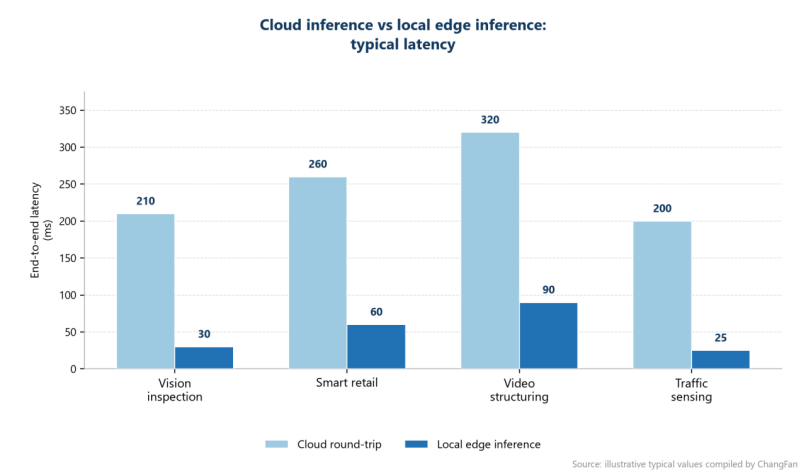
Figure 1 | Typical end-to-end latency: cloud inference vs local edge inference (illustrative typical values)
3. Scenario and Configuration Quick Reference
Scenario | Latency requirement | Compute tier | Environment | Key configuration |
Industrial vision inspection | <50 ms | 50~100 TOPS | Dust, oil mist | PoE LAN ports, fanless |
Smart retail | <200 ms | 20~50 TOPS | Indoor commercial | Compact and silent, Wi-Fi/5G |
Video structuring | <100 ms per stream | 100 TOPS class | Equipment room / telecom closet | Multiple LAN ports, encode-decode |
Traffic sensing | <50 ms | 50~100 TOPS | Outdoor wide temperature | -20 °C to 60 °C (-4 °F to 140 °F), 5G module |
Predictive maintenance | Seconds | 10~20 TOPS | Mounted beside equipment | Wide-range power input, vibration resistant |
Table 1 | Five scenarios: key requirements and recommended configuration tiers
4. Three Pitfalls to Avoid When Deploying
Environmental tolerance comes first. For outdoor and industrial sites fix the wide temperature range, ingress protection and vibration rating before you even discuss compute tiers.
Model operations are the long-term cost. Choose a system with OTA updates and containerised operations so model iterations do not depend on a vendor visit.
Put the lifecycle commitment in the contract. For volume projects write a five-year or longer supply and repair commitment into the purchasing terms.
5. Frequently Asked Questions
Q: How exactly do the edge and the cloud split the work?
Answer: Real-time inference runs at the edge, training and global optimisation run in the cloud. The box makes the millisecond decisions that require action now; the cloud handles cross-site model training, version management and macro analysis.
Q: Can an edge box run generative AI?
Answer: Yes, as quantised lightweight models — heavy workloads go back to the cloud. Quantised 7B~13B class models serve local knowledge bases and text processing, while content generation is still better in the cloud. Select on memory capacity and memory bandwidth, not on NPU TOPS alone.
Q: How is data privacy compliance handled?
Answer: The default architecture is "raw data never leaves the edge side". Video is analysed and anonymised inside the box and only metadata and features are uploaded; TPM and secure boot keep the device itself trustworthy.
Q: What is most often underestimated during deployment?
Answer: Site variation and model migration cost. A model that works in the lab is routinely challenged on site by lighting, camera angle and network conditions — reserving 30% of the schedule for tuning is standard practice.
Q: How long is the typical return on investment?
Answer: It depends on the scenario, usually 12~24 months. Inspection and security scenarios show the clearest ROI — calculate from the avoided cost of missed defects, bandwidth fees and labour, and run a 2~4 week POC before committing to volume deployment.
6. Start by Validating One Scenario
ChangFan (cfitsi.com) builds customised AI edge computing systems for system integrators and industry customers: hardware selection, mechanical and thermal design, and a pre-installed model deployment environment, with OEM/ODM support, a three-year warranty and global delivery.
See the server, industrial PC and network communication lines at cfitsi.com, send us your scenario and model requirements, and get scenario-specific configuration advice plus POC support (pricing subject to live quotation).
Product Link:https://www.cfitsi.com/ai-edge-computing-box-1
- Previous article there is none left
- Next article NVIDIA vs. Huawei vs. Intel vs. Rockchip: Choosing an AI Edge Computing Box Platform in 2026
